Muddy Points
Lesson 12: Interactions, Part 2
Muddy Points from Winter 2026
1. I’m confused about the difference between confounders and effect modifiers and how to identify them
Confounders are variables that are associated with both the exposure and the outcome and can create a spurious association between them. Confounders are something we need to adjust for in the model with a main effect. For example, if we are interested in the association between \(Y\) and \(X_1\), and we want to model \(X_2\) as a confounder, we would include \(X_2\) in the model as a main effect. The model would look like: \[Y = \beta_0 + \beta_1 X_1 + \beta_2 X_2 + \epsilon\]
Effect modifiers, on the other hand, are variables that modify the effect of the exposure on the outcome. We need to model how the effect modifier will change the exposure’s effect. Thus, we need an interaction term between the exposure and the effect modifier. For example, if we are interested in the association between \(Y\) and \(X_1\), and we want to model \(X_2\) as an effect modifier, we would include an interaction term between \(X_1\) and \(X_2\) in the model. The model would look like: \[Y = \beta_0 + \beta_1 X_1 + \beta_2 X_2 + \beta_3 X_1 X_2 + \epsilon\]
2. The end part of interactions with getting the confidence intervals for the slope and intercept and interpreting them was confusing to me. I don’t understand why the intercept wouldn’t be \(\widehat\beta_0 + 5 \cdot \widehat\beta_2\) based on the formula provided, but when Nicky wrote it out, it was \(\widehat\beta_0 + 5 \cdot \widehat\beta_1\)
Oops! That’s because I wrote it wrong. Will correct on the slides.
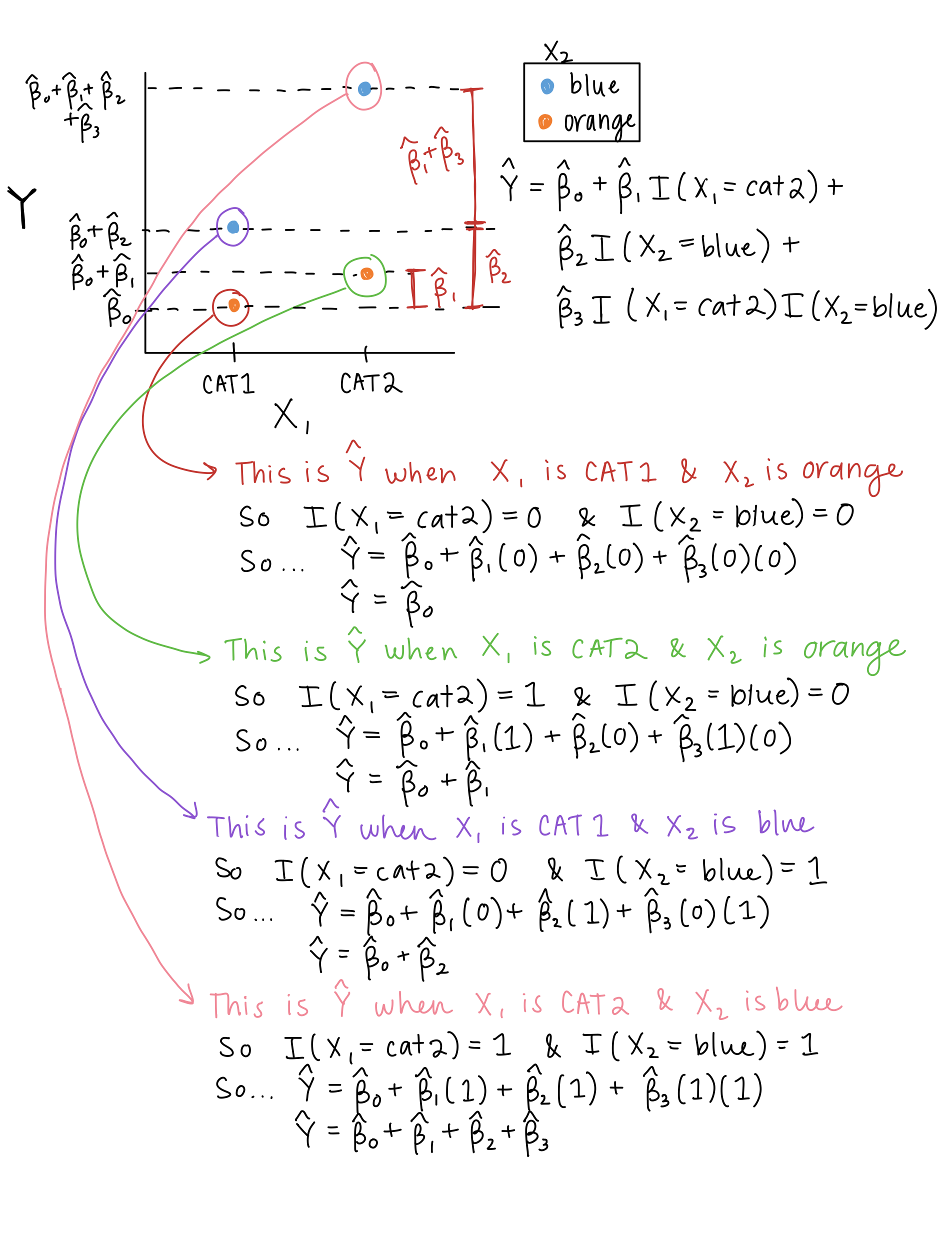
3. I got a little confused by the visual representation on slide 10
Let’s go through some visualization for an interaction between two binary variables \(X_1\) and \(X_2\):
Muddy Points from Winter 2024
1. Interactions in general
1.1 Why is it not an effect modifier if p-value is 0.4? Or why is it not significant? Is it because it is not = 0?
1.2 What are some reasons why we would think an effect modifier might exist in our data? or are we testing indiscriminately/ based on our own perspective of the associations in the data
1.3 I’m still not entirely sure I know how to do all the steps of interaction models, but I think part of that may just be me needing to look at my previous notes.
2. Centering the continuous covariate
2.1 How does centering help with interpretation?
I think this blog post has a nice explanation.
But for an example from our class… centering female literacy rate can help us interpret the… randomly stopped typing…