Muddy Points
Lesson 2: Introduction to Categorical Data Analysis
Muddy Points from Spring 2025
2. For Chi-squared test I was wondering whether or not it is always one-sided and under what circumstances it is two-sided. I vaguely remember that certain distributions (F-distribution, z-distribution, chi-squared, etc.)
Be careful with how you use “one-sided.” It usually refers to the hypothesis test statements (\(H_0\) vs. \(H_A\)). For example, \(H_0: \beta_1 = 0\) vs. \(H_0: \beta_1 \neq 0\) is two-sided test and \(H_0: \beta_1 = 0\) vs. \(H_0: \beta_1 > 0\) is a one-sided test.
However, I think you are asking if the probabilities can we calculate are always \(P(F > F_{stat})\). For the F-distribution and Chi-squared distribution, we only ever calculate the probability from the area under the curve to the right of our F-statistic.
Muddy Points from Spring 2024
1. Why does the test of trend treat ordinal variables as quantitative rather than qualitative?
When we treat something as qualitative, we can only look at differences between groups. This means we cannot rank the groups and look at the change across groups. By treating the ordinal variables as quantitative, we can look at the change as we move from one group to another (and over all the ranked categories).
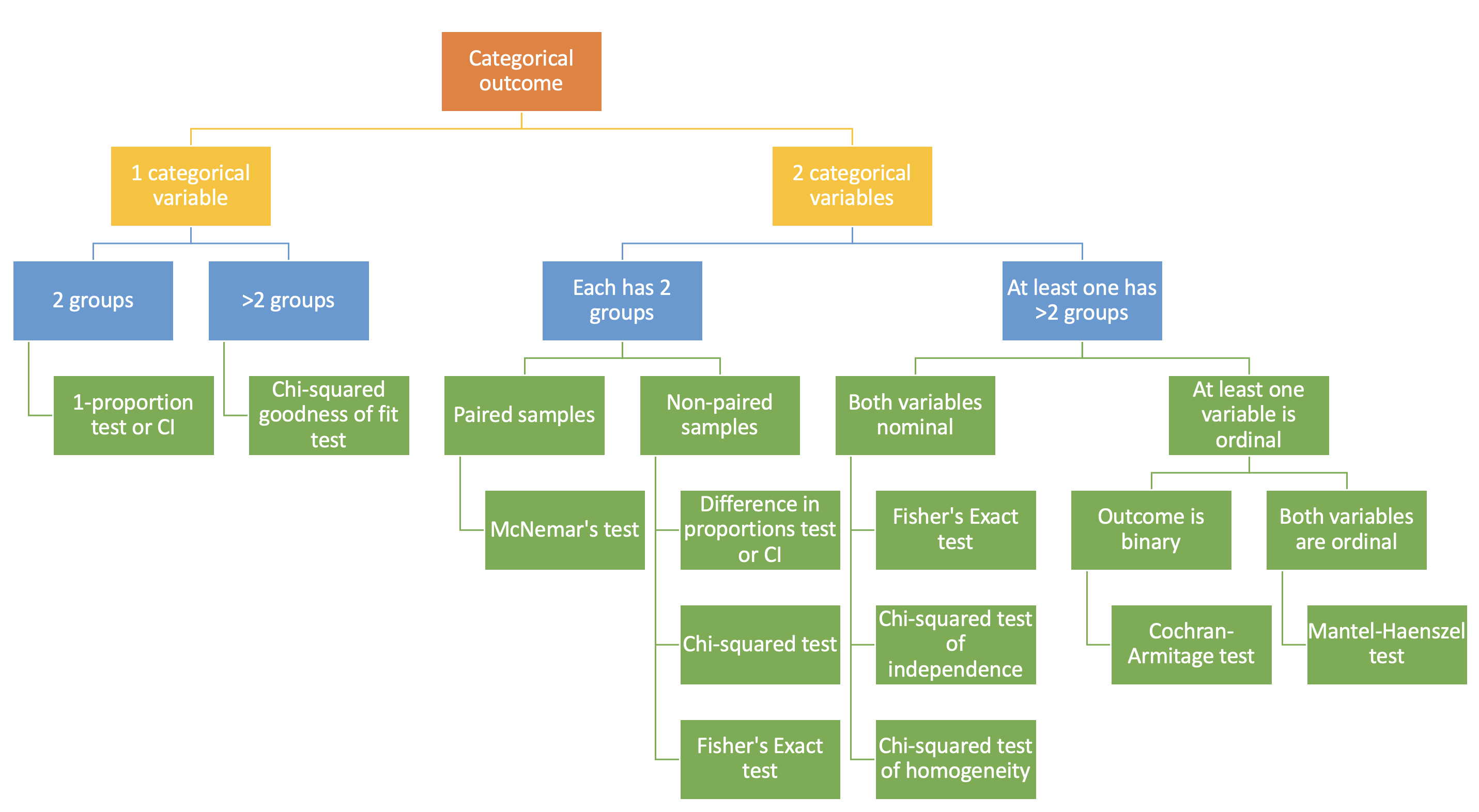
2. Organizing the tests in a tree
Here’s a organizational tree that I took from Meike and expanded: