2025-05-21
Review Generalized Linear Models and how we can branch to other types of regression.
Identify outcome, examples, population model, and interpretations for different generalized linear models.
Basically, we are just identifying the distribution for our outcome
If Y is binary: assumes a binomial distribution of Y
If Y is count: assumes Poisson or negative binomial distribution of Y
If Y is continuous: assumea Normal distribution of Y
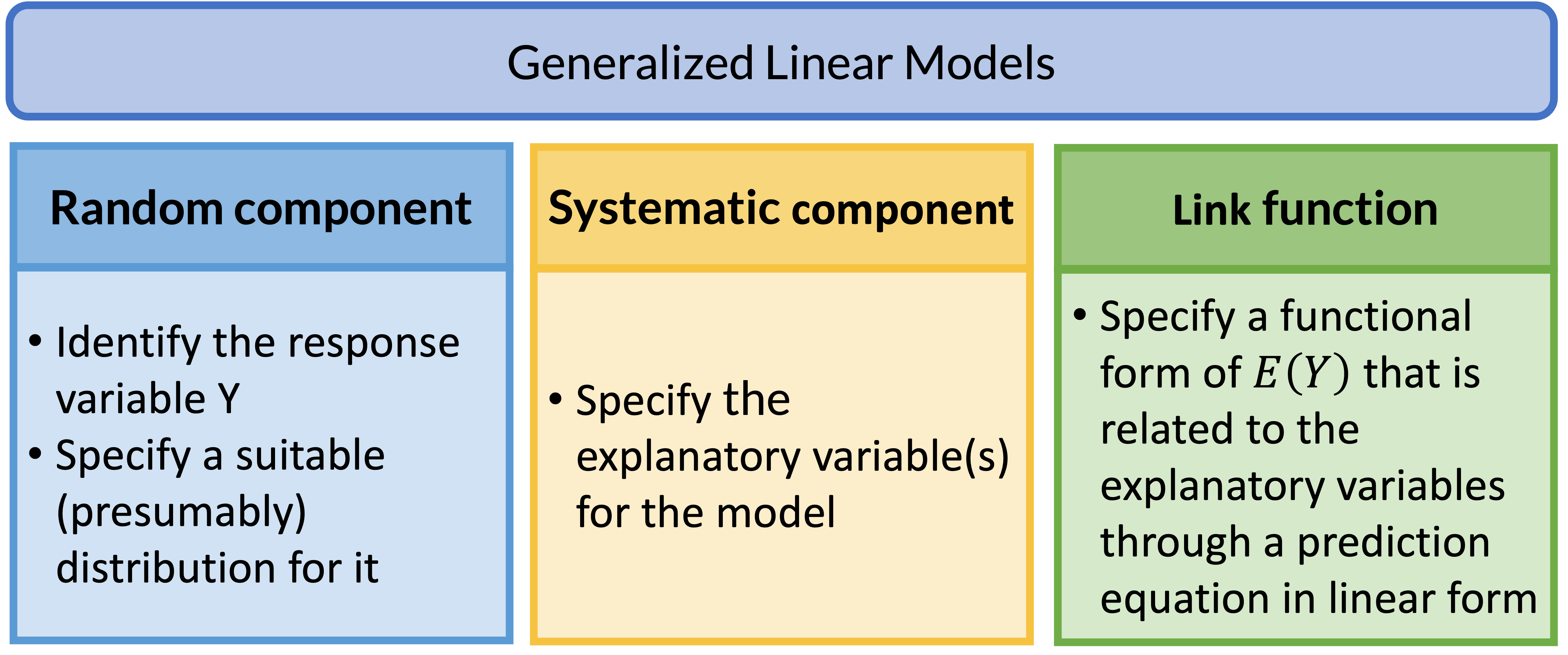
Above equation includes:
If \(\mu = E(Y)\), then the link function specifies a function \(g(.)\) that relates \(\mu\) to the linear predictors as: \[g\left(\mu\right)=\beta_0+\beta_1X_1+\ldots+\beta_kX_k\]
The link function connects the random component with the systematic component
Can also think of this as: \[\mu=g^{-1}\left(\beta_0+\beta_1X_1+\ldots+\beta_kX_k\right)\]
It’s basically like saying \(g\left(\mu\right)\) IS \(\text{logit} (\mu)\) and thus \[ \text{logit} (\mu)=\beta_0+\beta_1X_1+\ldots+\beta_kX_k\]
| Dist’n of Y | Typical uses | Link name | Link function | Common name |
|---|---|---|---|---|
| Normal | Linear-response data | Identity | \(g(\mu)=\mu\) | Linear regression |
| Bernoulli / Binomial | outcome of single yes/no occurrence | Logit | \(g(\mu)=\text{logit}(\mu)\) | Logistic regression |
| Poisson | count of occurrences in fixed amount of time/space | Log | \(g(\mu)=\log(\mu)\) | Poisson regression |
| Bernoulli / Binomial | outcome of single yes/no occurrence | Log | \(g(\mu)=\log(\mu)\) | Log-binomial regression |
| Multinomial | outcome of single occurence with K > 2 options, nominal | Logit | \(g(\mu)=\text{logit}(\mu)\) | Multinomial logistic regression |
| Multinomial | outcome of single occurence with K > 2 options, ordinal | Logit | \(g(\mu)=\text{logit}(\mu)\) | Ordinal logistic regression |
\[ E(Y \mid X) = \mu = \beta_0 + \beta_1 X\]


Model Selection
Building a model
Selecting variables
Prediction vs interpretation
Comparing potential models
Model Fitting
Find best fit line
Using OLS in this class
Parameter estimation
Categorical covariates
Interactions
Model Evaluation
Model Use (Inference)
\[ \text{logit}(\mu) = \text{logit}(\pi(X)) = \beta_0 + \beta_1 X\]


Model Selection
Build a model
Select variables
Prediction vs association
Comparing potential models
Model Fitting
Find model that maximizes likelihood function
Parameter estimation (MLEs)
Categorical covariates
Interactions
Model Evaluation
Model Use (Inference)
\[ \log(\mu) = \text{log}(\pi(X)) = \beta_0 + \beta_1 X\]
\[ \log(\mu) = \log(\lambda) = \beta_0 + \beta_1 X\]
Population models\[ \log \left(\dfrac{\mu_{\text{group } 2}}{\mu_{\text{group } 1}} \right) = \beta_0 + \beta_1 X\] \[ \log \left(\dfrac{\mu_{\text{group } 3}}{\mu_{\text{group } 1}} \right) = \beta_0 + \beta_1 X\]
Interpretations
\[ \log \left(\dfrac{P(Y \leq 1)}{P(Y > 1)} \right) = \beta_0 + \beta_1 X\] \[ \log \left(\dfrac{P(Y \leq k)}{P(Y > k)} \right) = \beta_0 + \beta_1 X\]
YouTube video on R tutorial for Poisson Regression
| Dist’n of Y | Typical uses | Link name | Link function | Common name |
|---|---|---|---|---|
| Bernoulli / Binomial | outcome of single yes/no occurrence | Probit | \(g(\mu)=\Phi^{-1}(\mu)\) | Probit regression |
| Bernoulli / Binomial | outcome of single yes/no occurrence | Complementary log-log | \(g(\mu)=\log(-\log(1-\mu))\) | Complementary log-log regression |
| Multinomial | outcome of single occurence with K > 2 options, nominal | Probit | \(g(\mu)=\Phi^{-1}(\mu)\) | Multinomial probit regression |
| Multinomial | outcome of single occurence with K > 2 options, ordinal | Probit | \(g(\mu)=\Phi^{-1}(\mu)\) | Ordered probit regression |
Lesson 15: Other types of categorical regression