05:00
Lab 3: Feedback and Discussion
Nicky Wakim
2025-05-12
Lab 3 Feedback
- Some fo you did main covariate + 4 other variables and some did main covariate + 5 other variables
- Okay either way
- In presentation of odds ratios (forest plot and tables), it’s important to include the reference group
- Gives the reader context for the comparison
Get into groups of 2-4
- No more than 4!
- Introduce yourself and your research question
- Share you html documents with each other (email, airdrop, etc.)
Help with forest plot: ordering categories
Let’s say I ran this model:
Help with forest plot: ordering categories
library(broom.helpers)
MLR_tidy0 = tidy_and_attach(model,  conf.int=T, exponentiate = T) %>%
  tidy_remove_intercept() %>%
  tidy_add_reference_rows() %>%
  tidy_add_estimate_to_reference_rows() %>%
  tidy_add_term_labels()

glimpse(MLR_tidy0)
Rows: 31
Columns: 16
$ term <chr> "PPINCIMP$10,000 to $12,499", "PPINCIMP$100,000 to $124…
$ variable <chr> "PPINCIMP", "PPINCIMP", "PPINCIMP", "PPINCIMP", "PPINCI…
$ var_label <chr> "PPINCIMP", "PPINCIMP", "PPINCIMP", "PPINCIMP", "PPINCI…
$ var_class <chr> "factor", "factor", "factor", "factor", "factor", "fact…
$ var_type <chr> "categorical", "categorical", "categorical", "categoric…
$ var_nlevels <int> 21, 21, 21, 21, 21, 21, 21, 21, 21, 21, 21, 21, 21, 21,…
$ contrasts <chr> "contr.treatment", "contr.treatment", "contr.treatment"…
$ contrasts_type <chr> "treatment", "treatment", "treatment", "treatment", "tr…
$ reference_row <lgl> TRUE, FALSE, FALSE, FALSE, FALSE, FALSE, FALSE, FALSE, …
$ label <chr> "$10,000 to $12,499", "$100,000 to $124,999", "$12,500 …
$ estimate <dbl> 1.000000000, 0.060863278, 0.873493696, 0.043281443, 0.8…
$ std.error <dbl> NA, 0.2175317, 0.1557261, 0.2940413, 0.1432175, 0.25032…
$ statistic <dbl> NA, -12.8676662, -0.8685401, -10.6788784, -1.1890139, -…
$ p.value <dbl> NA, 6.843892e-38, 3.850987e-01, 1.278065e-26, 2.344342e…
$ conf.low <dbl> NA, 0.0390983422, 0.6433397149, 0.0233193469, 0.6368560…
$ conf.high <dbl> NA, 0.09195374, 1.18491604, 0.07444924, 1.11676827, 0.1…Help with forest plot: ordering categories
plot_MLR0 = ggplot(data=MLR_tidy0,
       aes(y=label, x=estimate, xmin=conf.low, xmax=conf.high)) +
  geom_point(size = 3) +  geom_errorbarh(height=.2) +

  geom_vline(xintercept=1, color='#C2352F', linetype='dashed', alpha=1) +
  theme_classic() +

  facet_grid(rows = vars(var_label), scales = "free",
             space='free_y', switch = "y") +

  labs(x = "OR (95% CI)",
       title = "Odds ratios of food insecurity") +
  theme(axis.title = element_text(size = 12),
        axis.text = element_text(size = 12),
        title = element_text(size = 12),
        axis.title.y=element_blank(),
        strip.text = element_text(size = 12),
        strip.placement = "outside",
        strip.background = element_blank())
Help with forest plot: ordering categories
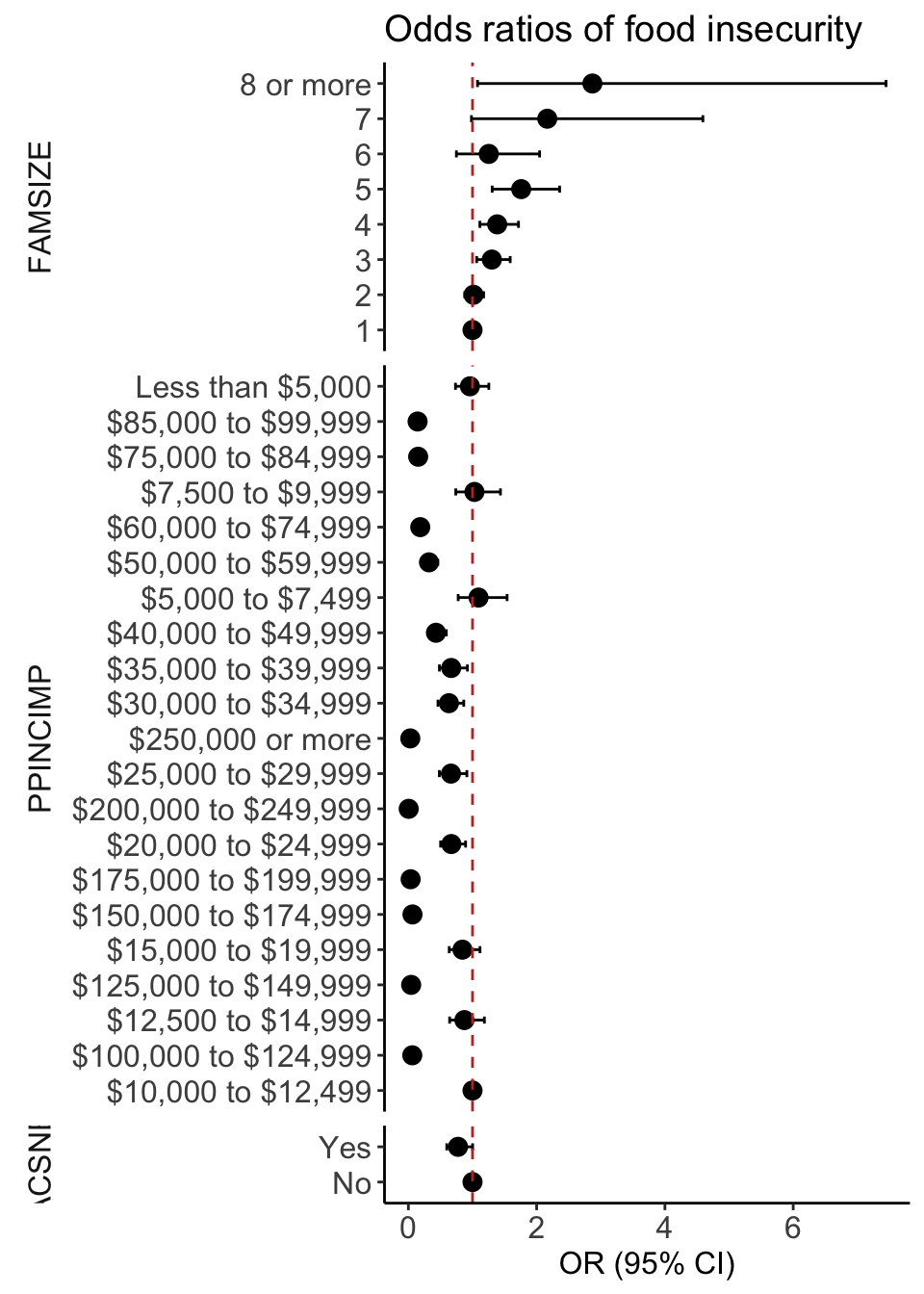
Help with forest plot: ordering categories
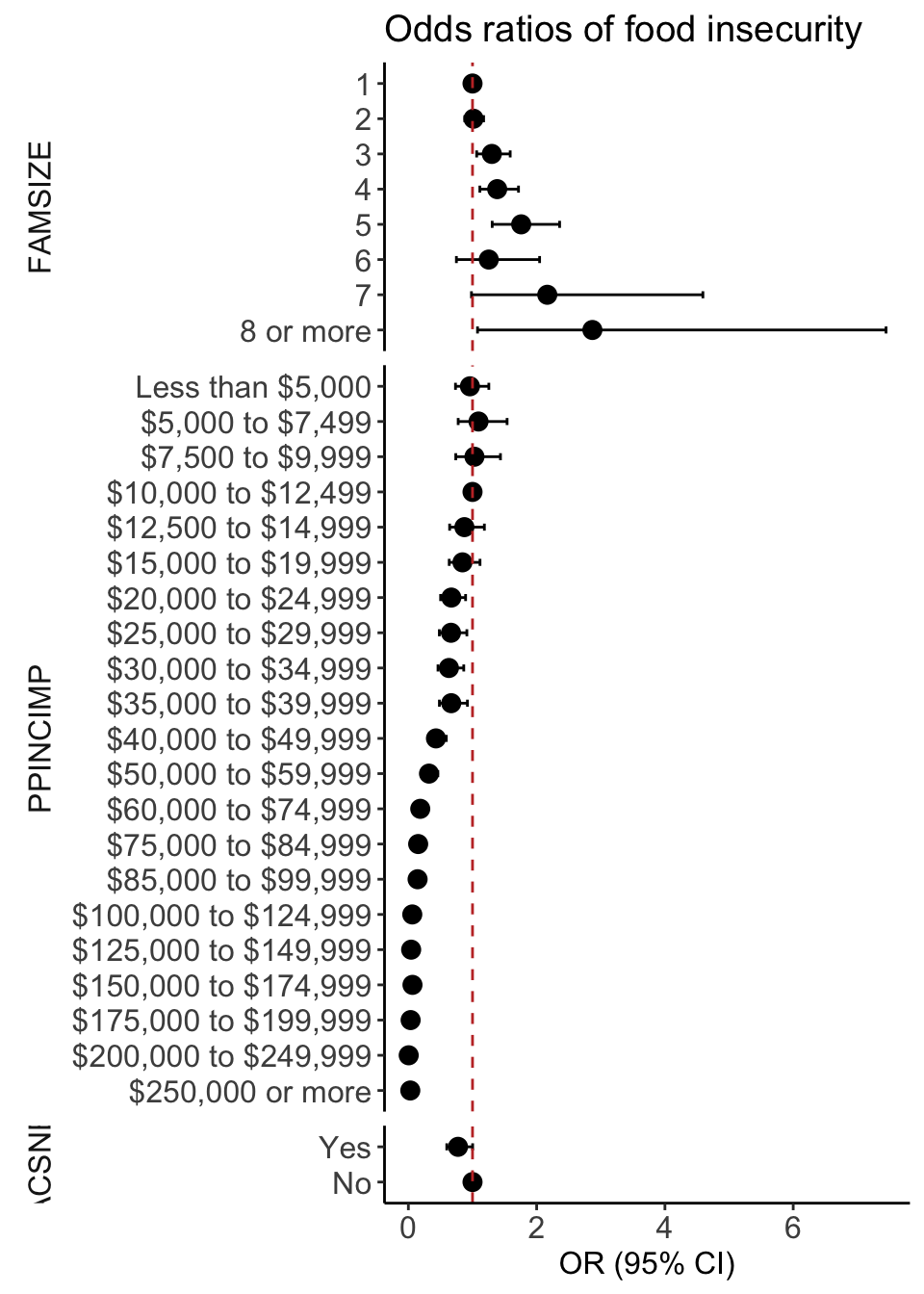
MLR_tidy = MLR_tidy0  %>%
              mutate(order = case_match(label,
                            "Less than $5,000" ~ 1,
                            "$5,000 to $7,499" ~ 2,
                            "$7,500 to $9,999" ~ 3,
                            "$10,000 to $12,499" ~ 4,
                            "$12,500 to $14,999" ~ 5,
                            "$15,000 to $19,999" ~ 6,
                            "$20,000 to $24,999" ~ 7,
                            "$25,000 to $29,999" ~ 8,
                            "$30,000 to $34,999" ~ 9,
                            "$35,000 to $39,999" ~ 10,
                            "$40,000 to $49,999" ~ 11,
                            "$50,000 to $59,999" ~ 12,
                            "$60,000 to $74,999" ~ 13,
                            "$75,000 to $84,999" ~ 14,
                            "$85,000 to $99,999" ~ 15,
                            "$100,000 to $124,999" ~ 16,
                            "$125,000 to $149,999" ~ 17,
                            "$150,000 to $174,999" ~ 18,
                            "$175,000 to $199,999" ~ 19,
                            "$200,000 to $249,999" ~ 20,
                            "$250,000 or more" ~ 21,
                            "1" ~ 1,
                            "2" ~ 2,
                            "3" ~ 3,
                            "4" ~ 4,
                            "5" ~ 5,
                            "6" ~ 6,
                            "7" ~ 7,
                            "8 or more" ~ 8,
                            .default = 0)) %>%
            mutate(label = fct_reorder(label, desc(order)))
Help with forest plot: ordering categories
plot_MLR = ggplot(data=MLR_tidy,
       aes(y=label, x=estimate, xmin=conf.low, xmax=conf.high)) +
  geom_point(size = 3) +  geom_errorbarh(height=.2) +

  geom_vline(xintercept=1, color='#C2352F', linetype='dashed', alpha=1) +
  theme_classic() +

  facet_grid(rows = vars(var_label), scales = "free",
             space='free_y', switch = "y") +

  labs(x = "OR (95% CI)",
       title = "Odds ratios of food insecurity") +
  theme(axis.title = element_text(size = 12),
        axis.text = element_text(size = 12),
        title = element_text(size = 12),
        axis.title.y=element_blank(),
        strip.text = element_text(size = 12),
        strip.placement = "outside",
        strip.background = element_blank())
Help with forest plot: ordering categories
Questions to consider
- How did you handle any categorical variables?
- Income, family size, number of children, etc
- Are the categories for the forest plot in order?
- How did you interpret your estimated odds ratios?
- If you have many categories in your main variable, do you see a trend?
- What might be a better way to report a trend?
- If you had interactions, how would your interpretation change?
Lab 3: Feedback and Discussion