Lesson 13: Expected Values
2025-11-10
Learning Objectives
Define the expected value for discrete and continuous RVs
Calculate the expected value (mean) of a single discrete RV
Calculate the expected value (mean) of a single continuous RV
Calculate expected value for the sum of discrete or continuous RVs
Calculate expected value for joint densities (continuous RVs)
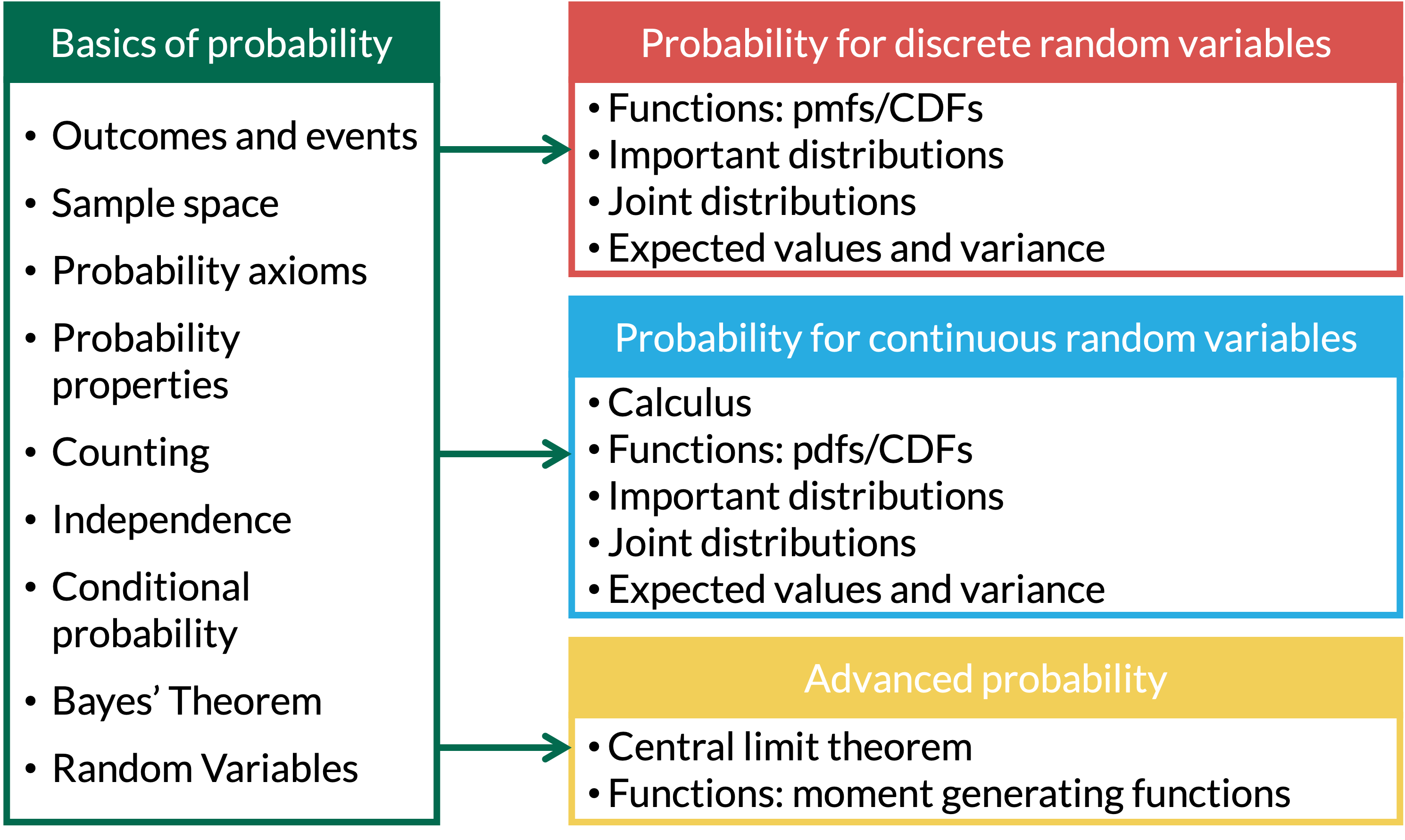
Where are we?
Learning Objectives
- Define the expected value for discrete and continuous RVs
Calculate the expected value (mean) of a single discrete RV
Calculate the expected value (mean) of a single continuous RV
Calculate expected value for the sum of discrete or continuous RVs
Calculate expected value for joint densities (continuous RVs)
Our good and fair friend, the 6-sided die
Example 1
Suppose you roll a fair 6-sided die. What value do you expect to get?
What is an expected value?
Definition: Expected value of discrete RV
The expected value of a discrete RV \(X\) that takes on values \(x_1, x_2, \ldots, x_n\) is \[\mathbb{E}[X] = \sum_{i=1}^n x_ip_X(x_i)\] where \(n\) can be \(\infty\)
Definition: Expected value of continuous RV
The expected value of a continuous RV \(X\) is \[\mathbb{E}[X] = \displaystyle\int_{-\infty}^\infty xf_X(x) dx\] where we adjust the integrand based on the bounds of \(X\)
- Expected values are not necessarily an actual outcome
- In previous example, we cannot roll a 3.5
- It could be that our expected value is not in the sample space (\(E(X) \notin S\))
Learning Objectives
- Define the expected value for discrete and continuous RVs
- Calculate the expected value (mean) of a single discrete RV
Calculate the expected value (mean) of a single continuous RV
Calculate expected value for the sum of discrete or continuous RVs
Calculate expected value for joint densities (continuous RVs)
Our good and not-so-fair friend, the 6-sided die
Example 2
Suppose the die is 6-sided, but not fair. And the probabilities of each side is distributed as:
| \(x\) | \(p_X(x)\) |
|---|---|
| 1 | 0.10 |
| 2 | 0.05 |
| 3 | 0.02 |
| 4 | 0.30 |
| 5 | 0.50 |
| 6 | 0.03 |
What value do you expect to get on a roll?
Expected value of a Bernoulli distribution
Example 3
Suppose \[X = \left\{ \begin{array}{ll} 1 & \quad \mathrm{with\ probability}\ p \quad\mathrm{(success)}\\ 0 & \quad \mathrm{with\ probability}\ 1-p \quad\mathrm{(failure)} \end{array} \right.\] Find the expected value of \(X\).
Let’s slightly change our random variable
Example 4
Suppose \[X = \left\{ \begin{array}{ll} 1 & \quad \mathrm{with\ probability}\ p \\ -1 & \quad \mathrm{with\ probability}\ 1-p \end{array} \right.\] Find the expected value of \(X\).
Learning Objectives
Define the expected value for discrete and continuous RVs
Calculate the expected value (mean) of a single discrete RV
- Calculate the expected value (mean) of a single continuous RV
Calculate expected value for the sum of discrete or continuous RVs
Calculate expected value for joint densities (continuous RVs)
Expected Value of the Uniform Distribution
Example 5
Let \(f_X(x)= \frac{1}{b-a}\), for \(a \leq x \leq b\). Find \(\mathbb{E}[X]\).
Expected Value of the Exponential Distribution
Example 6
Let \(f_X(x)= \lambda e^{-\lambda x}\), for \(x > 0\) and \(\lambda> 0\). Find \(\mathbb{E}[X]\).
Integrating by Parts
\(\displaystyle\int_a^b u dv = uv\bigg|^b_a - \displaystyle\int_a^b vdu\)
Learning Objectives
Define the expected value for discrete and continuous RVs
Calculate the expected value (mean) of a single discrete RV
Calculate the expected value (mean) of a single continuous RV
- Calculate expected value for the sum of discrete or continuous RVs
- Calculate expected value for joint densities (continuous RVs)
Revisiting our two card draw
Example 7
Suppose you draw 2 cards from a standard deck of cards with replacement. Let \(X\) be the number of hearts you draw. Find \(\mathbb{E}[X]\).
Recall Binomial RV with \(n=2\):
\[p_X(x) = {2 \choose x}p^x(1-p)^{2-x} \text{ for } x = 0, 1, 2\]
Sums of Random Variables
Theorem: Sum of random variables
For RVs (discrete or continuous) \(X_i\) and constants \(a_i\), \(i=1,2,\dots, n\), \[\mathbb{E}\Bigg[\sum_{i=1}^n a_iX_i\Bigg] = \sum_{i=1}^n a_i\mathbb{E}[X_i] .\] Remark: The theorem holds for infinitely RV’s \(X_i\) as well.
- For two RVs, \(X\) and \(Y\):
- We can say \(E[X+Y] = E[X] + E[Y]\)
- … and constant numbers \(a\) and \(b\), we can also say \(E[aX+bY] = aE[X] + bE[Y]\)
- We can also also say \(E[X-Y] = E[X] - E[Y]\), since \(b=-1\)
Corollaries from Theorem
Function with two constants
For a RV \(X\), and constants \(a\) and \(b\), \[\mathbb{E}[aX+b] = a\mathbb{E}[X] + b.\]
Expected value of sum of identically distributed RVs
If \(X_i\), \(i=1,2,\dots, n\), are identically distributed RV’s, then \[\mathbb{E}\bigg[\sum_{i=1}^n X_i\bigg] = n\mathbb{E}[X_1] .\]
Cost of hotel rooms
Example 8
A tour group is planning a visit to the city of Minneapolis and needs to book 30 hotel rooms. The average price of a room is $200. In addition, there is a 10% tourism tax for each room. What is the expected cost for the 30 hotel rooms?
Learning Objectives
Define the expected value for discrete and continuous RVs
Calculate the expected value (mean) of a single discrete RV
Calculate the expected value (mean) of a single continuous RV
Calculate expected value for the sum of discrete or continuous RVs
- Calculate expected value for joint densities (continuous RVs)
Expected value of one RV from joint pdf
If you have a joint distribution \(f_{X,Y}(x,y)\) and want to calculate \(\mathbb{E}[X]\), you have two options:
Find \(f_X(x)\) and use it to calculate \(\mathbb{E}[X]\).
Calculate \(\mathbb{E}[X]\) using the joint density: \[\mathbb{E}[X] = \int_{-\infty}^{\infty}\int_{-\infty}^{\infty}x f_{X,Y}(x,y)dydx.\]
You can do the same for \(\mathbb{E}[Y]\)!
Option 1: Find marginal first
Example 9
Let \(f_{X,Y}(x,y)= 2e^{-(x+y)}\), for \(0 \leq x \leq y\). Find \(\mathbb{E}[X]\).
Do this one at home by finding \(f_X(x)\) then \(\mathbb{E}[X] = \displaystyle\int_{-\infty}^\infty xf_X(x) dx\). See if you get the same result as next page’s answer!
Option 2: Expected value from a joint distribution
Example 9
Let \(f_{X,Y}(x,y)= 2e^{-(x+y)}\), for \(0 \leq x \leq y\). Find \(\mathbb{E}[X]\).
Learning Objectives
Define the expected value for discrete and continuous RVs
Calculate the expected value (mean) of a single discrete RV
Calculate the expected value (mean) of a single continuous RV
Calculate expected value for the sum of discrete or continuous RVs
Calculate expected value for joint densities (continuous RVs)
Lesson 13 Slides