Lesson 14: Variance
2025-11-12
Learning Objectives
Define and calculate the expected value for a function of discrete and continuous RVs
Define and calculate variance for a single random variable
Define and calculate variance for multiple random variables
Where are we?
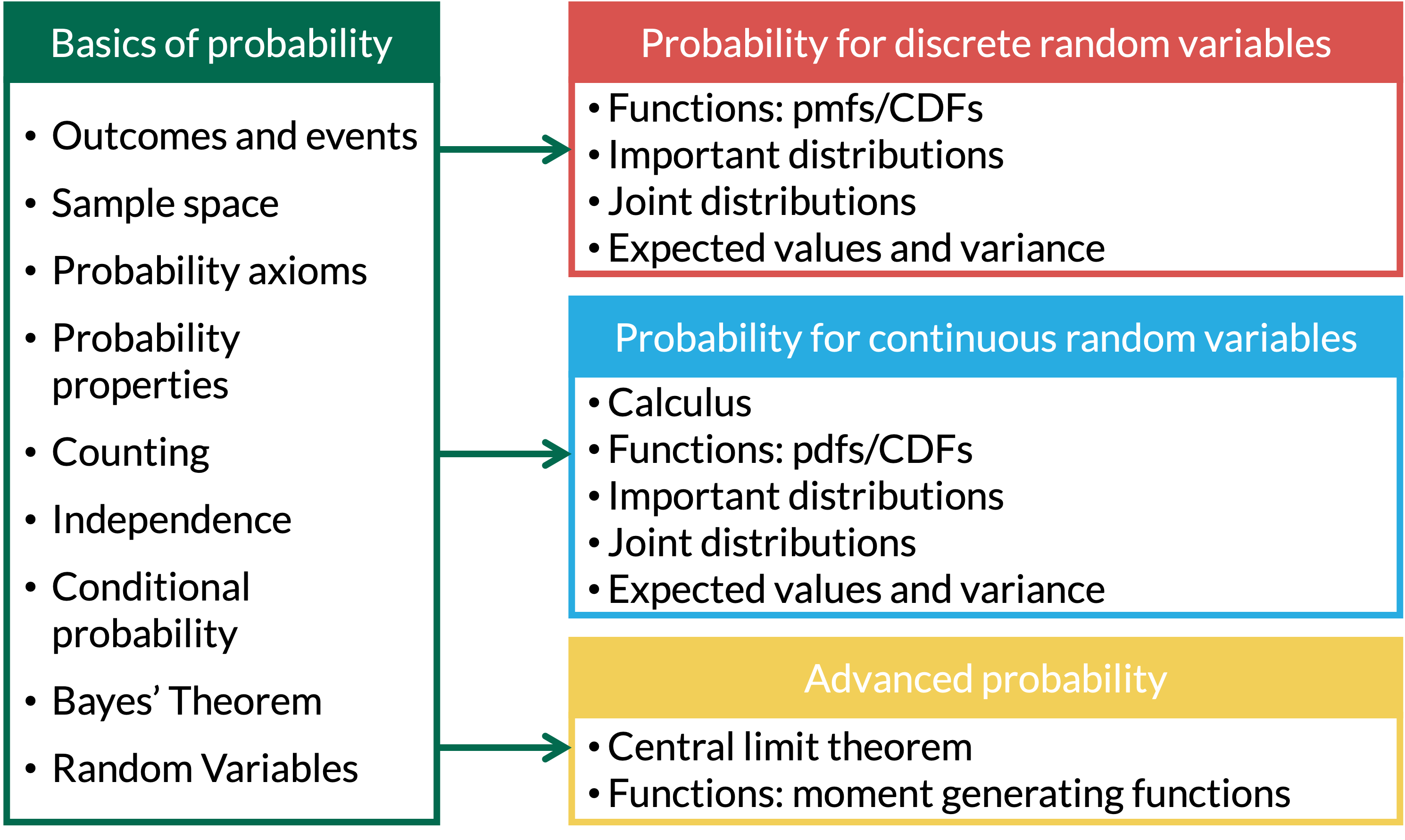
Learning Objectives
- Define and calculate the expected value for a function of discrete and continuous RVs
- Define and calculate variance for a single random variable
- Define and calculate variance for multiple random variables
Let’s start building the variance through expected values of functions
Example 1
Let \(g\) be a function and let \(g(x) = ax+b\), for real-valued constants \(a\) and \(b\). What is \(\mathbb{E}[g(X)]\)?
What is the expected value of a function?
Expected value of function of discrete RV
For any function \(g\) and discrete RV \(X\), the expected value of \(g(X)\) is \[\mathbb{E}[g(X)] = \sum_{\{all\ x\}}\ g(x) p_X(x)\]
Expected value of function of continuous RV
For any function \(g\) and continuous RV \(X\), the expected value of \(g(X)\) is \[\mathbb{E}[g(X)] = \displaystyle\int_{-\infty}^\infty g(x)f_X(x) dx\]
- For example, if we have \(g(x)=x^2\), then \[\mathbb{E}[X^2)] = \sum_{\{all\ x\}}\ x^2 p_X(x) \neq \left(\sum_{\{all\ x\}}\ x p_X(x)) \right)^2 = \left( \mathbb{E}[X] \right)^2\]
Let’s revisit the card example (1/2)
Example 2
Suppose you draw 2 cards from a standard deck of cards with replacement. Let \(X\) be the number of hearts you draw.
- Find \(\mathbb{E}[X^2]\).
Recall Binomial RV with \(n=2\):
\[p_X(x) = {2 \choose x}p^x(1-p)^{2-x} \text{ for } x = 0, 1, 2\]
Let’s revisit the card example (2/2)
Example 2
Suppose you draw 2 cards from a standard deck of cards with replacement. Let \(X\) be the number of hearts you draw.
- Find \(\mathbb{E}\big[\big(X-\frac{1}{2}\big)^2\big]\).
Recall Binomial RV with \(n=2\):
\[p_X(x) = {2 \choose x}p^x(1-p)^{2-x} \text{ for } x = 0, 1, 2\]
Learning Objectives
- Define and calculate the expected value for a function of discrete and continuous RVs
- Define and calculate variance for a single random variable
- Define and calculate variance for multiple random variables
Variance of a RV
Definition: Variance of RV
The variance of a RV \(X\), with (finite) expected value \(\mu_X=\mathbb{E}[X]\) is \[\sigma_X^2=Var(X)=\mathbb{E}[(X-\mu_X)^2] = \mathbb{E}[(X-\mathbb{E}[X])^2]\]
Definition: Standard deviation of RV
The standard deviation of a RV \(X\) is \[\sigma_X = SD(X) = \sqrt{\sigma_X^2}=\sqrt{Var(X)}.\]
Variance of discrete and continuous RVs
How do we calculate the variance of a discrete RV?
For discrete RVs:
\[ \begin{align} Var(X) & = \\ & = \sum_{\{all\ x\}}(x-\mu_x)^2 p_{X}(x) \\ & = \mathbb{E}[(X-\mu_X)^2] \\ & = \mathbb{E}[(X-\mathbb{E}[X])^2] \\ &= \mathbb{E}[X^2]-(\mathbb{E}[X])^2 \end{align} \]
How do we calculate the variance of a continuous RV?
For continuous RVs:
\[ \begin{align} Var(X) & = \displaystyle\int_{-\infty}^\infty (x-\mu_X)^2f_X(x) dx \\ & = \mathbb{E}[(X-\mu_X)^2] \\ & = \mathbb{E}[(X-\mathbb{E}[X])^2] \\ &= \mathbb{E}[X^2]-(\mathbb{E}[X])^2 \end{align} \]
Let’s calculate the variance and prove it! (1/2)
Lemma 6: “Computation formula” for Variance
The variance of a RV \(X\), can be computed as \[\begin{align} \sigma_X^2 & =Var(X) \\ & = \mathbb{E}[X^2]-\mu_X^2 \\ & = \mathbb{E}[X^2] - (\mathbb{E}[X])^2 \end{align}\]
Let’s calculate the variance and prove it! (2/2)
Variance of an Uniform distribution
Example 2
Let \(f_X(x)= \frac{1}{b-a}\), for \(a \leq x \leq b\). Find \(Var[X]\).
Variance of exponential distribution
In the homework:
Example 3
Let \(f_X(x)= \lambda e^{-\lambda x}\), for \(x > 0\) and \(\lambda> 0\). Find \(Var[X]\).
Learning Objectives
Define and calculate the expected value for a function of discrete and continuous RVs
Define and calculate variance for a single random variable
- Define and calculate variance for multiple random variables
Variance of a function with a single RV
Lemma 7
For a RV \(X\) and constants \(a\) and \(b\), \[Var(aX+b) = a^2Var(X).\]
Proof will be exercise in homework. It’s fun! In a mathy kinda way.
Important results for independent RVs
Theorem 8
For independent RV’s \(X\) and \(Y\), and functions \(g\) and \(h\), \[\mathbb{E}[g(X)h(Y)] = \mathbb{E}[g(X)]\mathbb{E}[h(Y)].\]
Corollary 1
For independent RV’s \(X\) and \(Y\), \[\mathbb{E}[XY] = \mathbb{E}[X]\mathbb{E}[Y].\]
Variance of sum of independent discrete RVs
Theorem 9: Variance of sum of independent discrete RV’s
For independent discrete RV’s \(X_i\) and constants \(a_i\), \(i=1,2,\dots, n\), \[Var\Bigg(\sum_{i=1}^n a_iX_i\Bigg) = \sum_{i=1}^n a_i^2Var(X_i).\]
Simpler version:
\[Var(a_1 X + a_2 Y) = Var(a_1X) + Var(a_2 Y) = a_1^2 Var(X) + a_2^2 Var(Y)\]
Corollaries
Corollary 2
For independent discrete RV’s \(X_i\), \(i=1,2,\dots, n\), \[Var\Bigg(\sum_{i=1}^n X_i\Bigg) = \sum_{i=1}^n Var(X_i).\]
Corollary 3
For independent identically distributed (i.i.d.) discrete RV’s \(X_i\), \(i=1,2,\dots, n\), \[Var\Bigg(\sum_{i=1}^n X_i\Bigg) = n Var(X_1).\]
Ghost problem: with replacement
Example 3.2
The ghost is trick-or-treating at a different house now. In this case it is known that the bag of candy has 10 chocolates, 20 lollipops, and 30 laffy taffies. The ghost grabs a handful of five pieces of candy. What is the variance for the number of chocolates the ghost takes? Let’s solve this for the cases with replacement.
Recall probability with replacement:
\[ p_X(x) = {n \choose k}p^k(1-p)^{n-k} \]
Back to our hotel example from Lesson 13
Example 4
A tour group is planning a visit to the city of Minneapolis and needs to book 30 hotel rooms. The average price of a room is $200 with standard deviation $10. In addition, there is a 10% tourism tax for each room. What is the standard deviation of the cost for the 30 hotel rooms? Assume rooms are independent.
Problem to do at home if we don’t have enough time.
Find the mean and sd from word problem (1/2)
Example 4
A machine manufactures cubes with a side length that varies uniformly from 1 to 2 inches. Assume the sides of the base and height are equal. The cost to make a cube is 10 ¢ per cubic inch, and 5 ¢ cents for the general cost per cube. Find the mean and standard deviation of the cost to make 10 cubes.
Find the mean and sd from word problem (1/2)
Lesson 14 Slides