[1] 0.5Lesson 16: Some Important Continuous RVs
Meike Niederhausen and Nicky Wakim
2025-11-19
Learning Objectives
- Distinguish between Uniform, Exponential, Gamma, and Normal distributions when reading a word problem.
- Identify the variable and the parameters in a word problem, and state what the variable and parameters mean.
- Use the formulas for the pdf/CDF, expected value, and variance to answer questions and find probabilities.
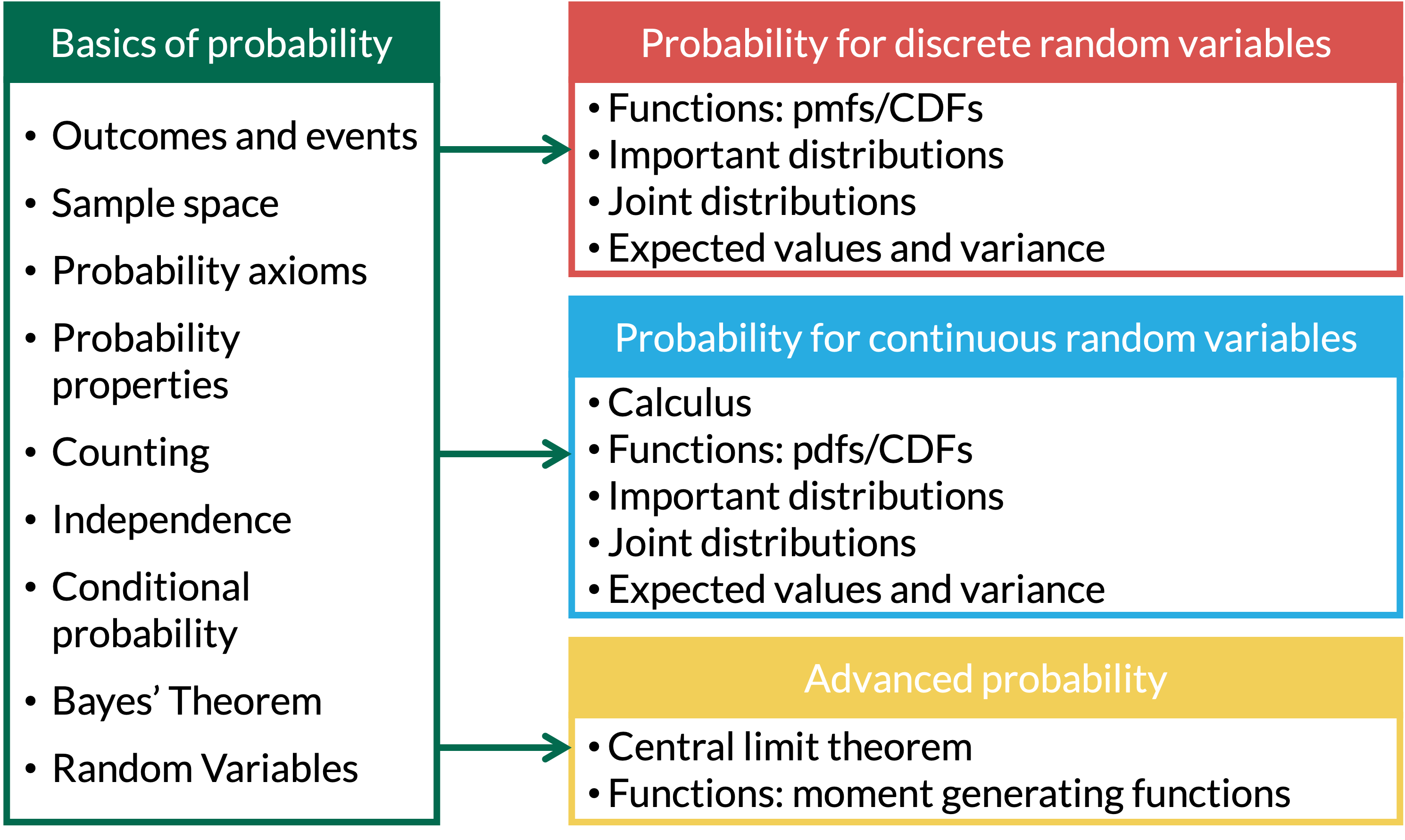
Where are we?
Continuous uniform RVs
Properties of continuous uniform RVs
Scenario: Events are equally likely to happen anywhere or anytime in an interval of values
Shorthand: \(X \sim \text{U}[a,b]\)
\[ f_X(x) = \dfrac{1}{b-a}, \text{ for }a \leq x \leq b \]
\[ F_X(x) = \left\{ \begin{array}{ll} 0 & \quad x<a \quad \\ \dfrac{x-a}{b-a} & \quad a \leq x \leq b\quad \\ 1 & \quad x>b \quad \end{array} \right. \]
\[\text{E}(X) = \dfrac{a+b}{2} \text{, } \text{ Var}(X) = \dfrac{(b-a)^2}{12}\]
Identifying continuous uniform RV from word problems
Look for some indication that all events are equally likely
- Could also say “uniformly distributed”
Look for an interval
Time example: Costumer in your store will approach the cash register in next 30 minutes. Approaching the register throughout the 30 minutes is equally likely.
Length example: You have a 12 inch string that you need to cut. You are equally likely to cut anywhere on the string.
Different than the discrete uniform
Discrete usually includes a countable number of events that are equally likely
Continuous is not countable
- Exact time and length can be measured with infinite decimal places
Helpful R code
Let’s say we’re looking at equally likely arrival times between 10 am and 11 am.
If we want to know the probability that someone arrives at 10:30am or earlier:
If we want to know the time, say \(t\), where the probability of arriving at \(t\) or earlier is 0.35:
If we want to know the probability that someone arrives between 10:14 and 10:16 am:
If we want to sample 20 arrival times from the distribution:
Bird on a wire (TB 31.5)
Example 1
A bird lands at a location that is Uniformly distributed along an electrical wire of length 150 feet. The wire is stretched tightly between two poles. What is the probability that the bird is 20 feet or less from one or the other of the poles?
Exponential RVs
Properties of exponential RVs
Scenario: Modeling the time until the next (first) event
Continuous analog to the geometric distribution!
Shorthand: \(X \sim \text{Exp}(\lambda)\)
\[ f_X(x) = \lambda e^{-\lambda x}\text{ for } x>0, \lambda>0 \]
\[ F_X(x) = \left\{ \begin{array}{ll} 0 & \quad x<0 \quad \\ 1 - e^{-\lambda x} & \quad x\geq0 \\ \end{array} \right. \]
\[\text{E}(X) = \dfrac{1}{\lambda}\] \[\text{Var}(X) = \dfrac{1}{\lambda^2}\]
Memoryless Property
If \(b>0\),
\[P(X > a +b | X> a) = P(X > b)\]
This can be interpreted as:
If you have waited \(a\) seconds (or any other measure of time) without a success
Then the probability that you have to wait \(b\) more seconds is the same as as the probability of waiting \(b\) seconds initially.
Identifying exponential RV from word problems
Look for time between events/successes
Look for a rate of the events over time period
How does it differ from the geometric distribution?
Geometric is number of trials until first success
Exponential is time until first success
Relation to the Poisson distribution?
- When the time between arrivals is exponential, the number of arrivals in a fixed time interval is Poisson with the mean \(\lambda\)
Helpful R code
Let’s say we’re sitting at the bus stop, measuring the time until our bus arrives. We know the bus comes every 10 minutes on average.
If we want to know the probability that the bus arrives in the next 5 minutes:
If we want to know the time, say \(t\), where the probability of the bus arriving at \(t\) or earlier is 0.35:
If we want to know the probability that the bus arrives between 3 and 5 minutes:
If we want to sample 20 bus arrival times from the distribution:
Transformation of independent exponential RVs
Revisit after joint notes:
Example 2
Let \(X_i \sim \textrm{Exp}(\lambda_i)\) be independent RVs, for \(i=1 \ldots n\). Find the pdf for the first of the arrival times.
Gamma RVs
Properties of gamma RVs
- Scenario: Modeling the time until the \(r^{th}\) event.
- Continuous analog to the Negative Binomial distribution
- Shorthand: \(X \sim \text{Gamma}(r, \lambda)\) or \(X \sim \text{Gamma}(\alpha, \beta)\)
\[ f_X(x) = \dfrac{\lambda^r}{\Gamma(r)}x^{r-1} e^{-\lambda x}\text{ for } x>0, \lambda>0, \Gamma(r) = (r-1)! \]
\[ F_X(x) = \left\{ \begin{array}{ll} 0 & \quad x<0 \quad \\ 1 - e^{-\lambda x}\displaystyle\sum_{j=0}^{r-1}\dfrac{(\lambda x)^j}{j!} & \quad x\geq0 \\ \end{array} \right. \]
\[\text{E}(X) = \dfrac{r}{\lambda}\text{, }\text{ Var}(X) = \dfrac{r}{\lambda^2}\]
Common to see \(\alpha = r\) and \(\beta = \lambda\)
Identifying gamma RV from word problems
Gamma distribution with \(r=1\) is same as exponential
- Just like Negative Binomial with \(r=1\) is same as the geometric distribution
Similar to exponential
- Look for time between or until events/successes
- BUT now we are measuring time until more than 1 success
- Look for a rate of the events over time period
- Look for time between or until events/successes
Helpful R code
Let’s say we’re sitting at the bus stop, measuring the time until 4 buses arrive. We know the bus comes every 10 minutes on average.
- If we want to know the probability that the 4 buses arrive in the next 50 minutes:
If we want to know the time, say \(t\), where the probability of the 4 buses arriving at \(t\) or earlier is 0.35:
If we want to know the probability that the 4 buses arrives between 30 and 50 minutes:
If we want to sample 20 arrival times for the 4 buses:
Remarks
The parameter \(r\) in a Gamma(\(r\),\(\lambda\)) distribution does NOT need to be a positive integer
- \(r\) is usually a positive integer
When \(r\) is a positive integer, the distribution is sometimes called an Erlang(\(r\),\(\lambda\)) distribution
When \(r\) is any positive real number, we have a general gamma distribution that is usually instead parameterized by \(\alpha>0\) and \(\beta>0\), where:
\(\alpha = \text{shape parameter}\) : same as \(k\), the total number of events we must witness
- In R code example: 4 buses to wait for
\(\beta = \text{scale parameter}\) : same as \(\lambda\), the rate parameter
- In R code example: 1 bus per 10 minutes (1/10)
Sending money orders
Example 3
On average, someone sends a money order once per 15 minutes. What is the probability someone sends 10 money orders in less than 3 hours?
Additional Resource
- Another helpful site with R code: https://rpubs.com/mpfoley73/459051
Normal RVs
Properties of Normal RVs
No scenario description here because the Normal distribution is so universal
- Central Limit Theorem (next class) makes it applicable to many types of events
Shorthand: \(X \sim \text{Normal}(\mu, \sigma^2)\)
\[ f_X(x) = \dfrac{1}{\sqrt{2\pi \sigma^2}}e^{-(x-\mu)^2/(2\sigma^2)} \text{, for} -\infty < x < \infty \]
\[\text{E}(X) = \mu \] \[\text{Var}(X) = \sigma^2\]
Helpful R code
Let’s say we’re measuring the high temperature today. The average high temperature on this day across many, many years is 50 degrees with a standard deviation of 4 degrees.
If we want to know the probability that the high temperature is below 45 degrees:
If we want to know the temoerature, say \(t\), where the probability of that the temperature is at \(t\) or lower is 0.35:
If we want to know the probability that the temperature is between 45 and 50 degrees:
If we want to sample 20 days’ temperature (over the years) from the distribution:
Movie night while studying
Example 4
Children’s movies run an average of 98 minutes with a standard deviation of 10 minutes. You check out a random movie from the library to entertain your kids so you can study for your test. Assume that your kids will be occupied for the entire length of the movie.
What is the probability that your kids will be occupied for at least the 2 hours you would like to study?
What is range for the bottom quartile (lowest 25%) of time they will be occupied?
Standard Normal Distribution
\[ Z \sim \text{Normal}(\mu = 0, \sigma^2 = 1)\]
Used to be more helpful when computing was not as advanced
Use tables of the standard normal
You can convert any normal distribution to a standard normal through transformation
\(Z = \dfrac{X - \mu_X}{\sigma_X}\)
Comes from \(X = \sigma_X Z + \mu_X\)
Since \(\sigma_X\) and \(\mu_X\) are constants, then \(E(X) = \mu_X\) and \(SD(X) = \sigma_X\)
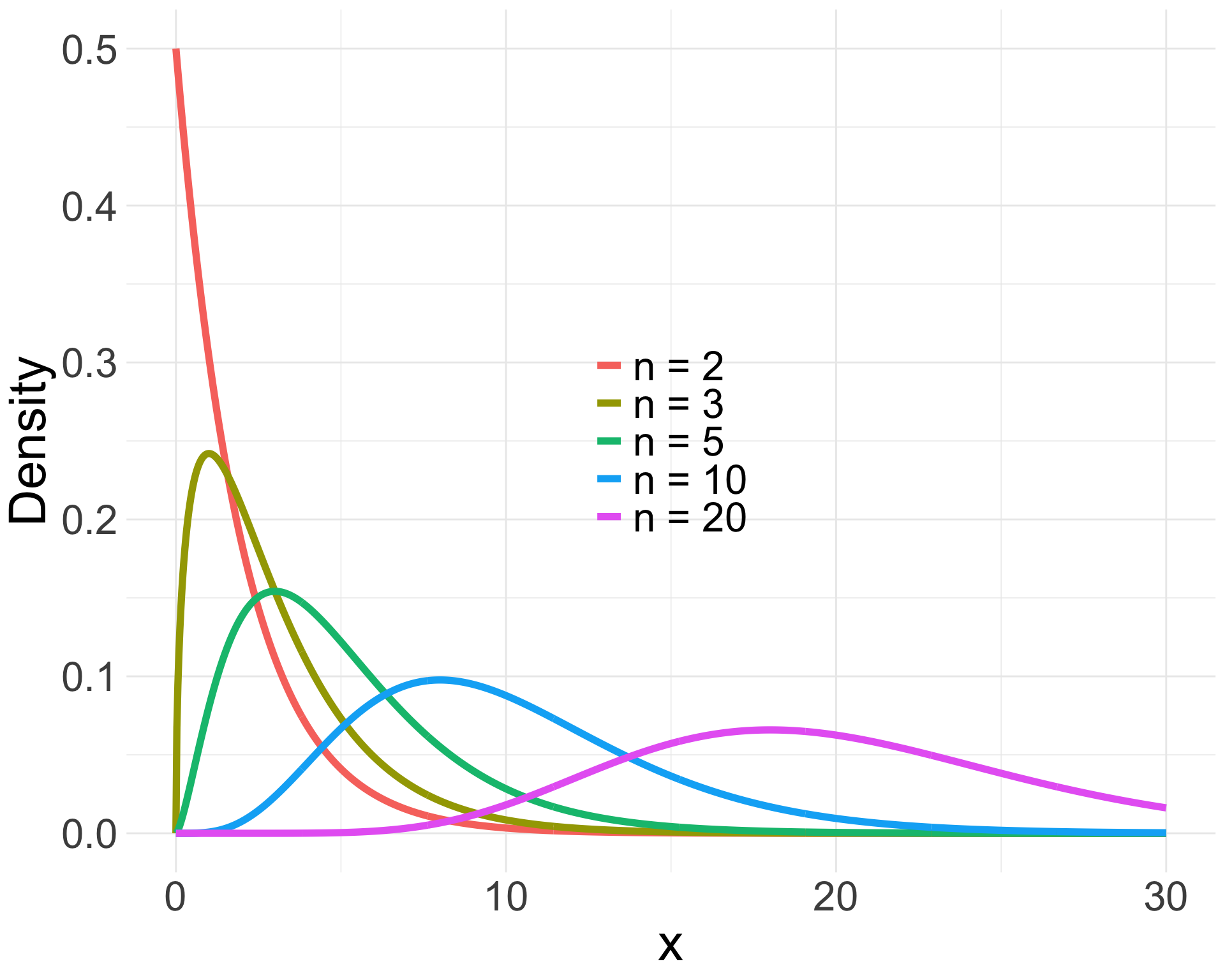
Chi-squared distribution
If \(Z \sim \text{Normal}(0,1)\), then \(X = Z^2\) has a Chi-squared distribution with 1 degree of freedom
- Shorthand: \(X \sim \chi^2_{(1)}\)
If \(Z_1, Z_2, \ldots, Z_n\) are independent standard normal RVs, then
\[X = \sum_{i=1}^n Z_i^2\]
has a Chi-squared distribution with \(n\) degrees of freedom
- Shorthand: \(X \sim \chi^2_{(n)}\)
Lesson 16 Slides