TB sections 3.4
2025-10-27
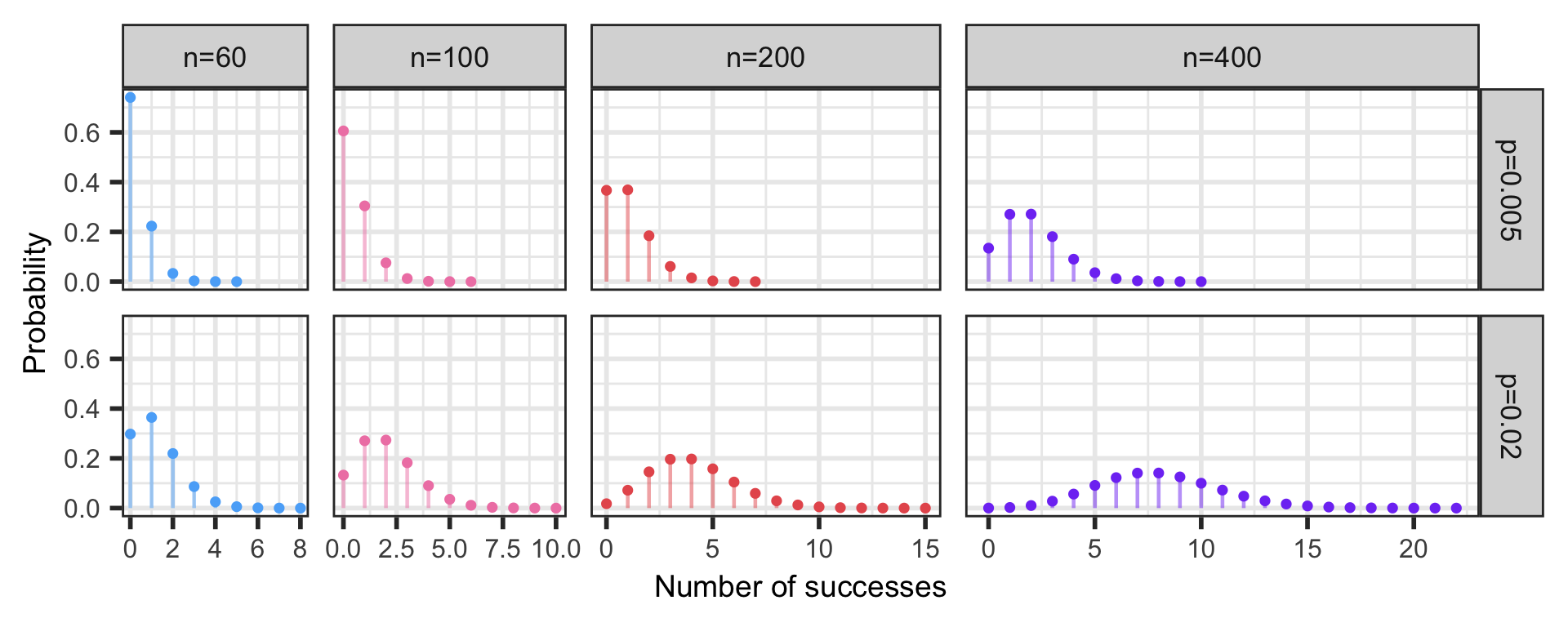
The Poisson distribution is often used to model count data (# of successes), especially for rare events
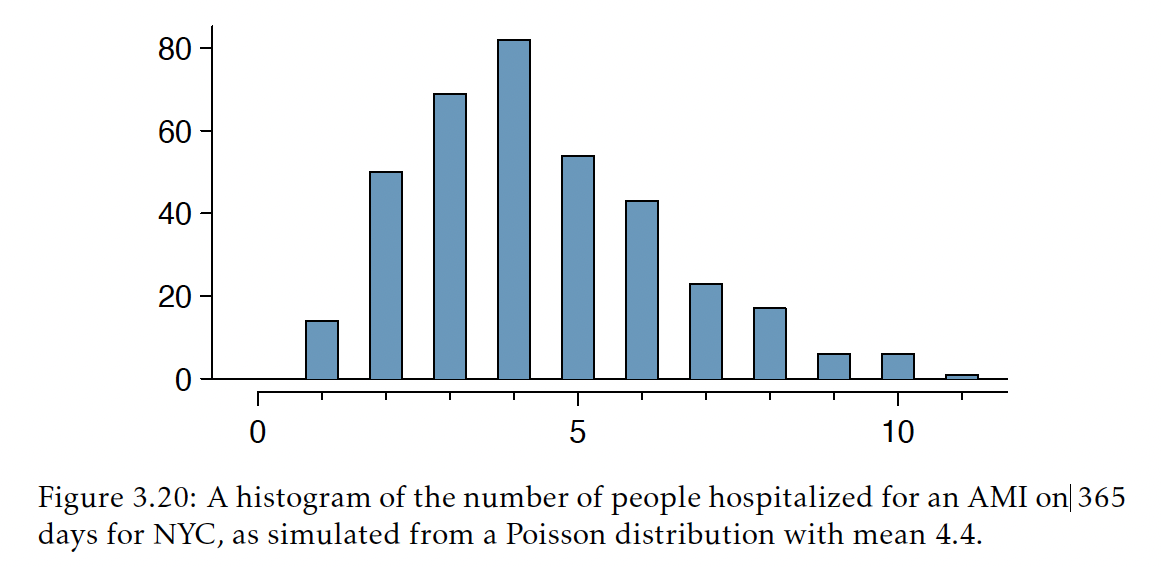
Example: historical records of hospitalizations in New York City indicate that an average of 4.4 people are hospitalized each day for an acute myocardial infarction (AMI)

Suppose events occur over time in such a way that
The probability an event occurs in an interval is proportional to the length of the interval.
Events occur independently at a rate \(\lambda\) per unit of time.
Then the probability of exactly \(x\) events in one unit of time is \[ P(X = k) = \frac{e^{-\lambda}\lambda^{k}}{k!}, \,\, k = 0, 1, 2, \ldots \]
For the Poisson distribution modeling the number of events in one unit of time:
The mean is \(\lambda\).
The standard deviation is \(\sqrt{\lambda}\).
Shorthand for a random variable, \(X\), that has a Poisson distribution: \[X \sim \text{Pois}(\lambda)\]
R commands with their input and output:
| R code | What does it return? |
|---|---|
rpois() |
returns sample of random variables with specified Poisson distribution |
dpois() |
returns value of probability density at certain point of the Poisson distribution |
ppois() |
returns cumulative probability of getting certain point (or less) of the Poisson distribution |
qpois() |
returns number of cases corresponding | to desired quantile |
Typhoid fever
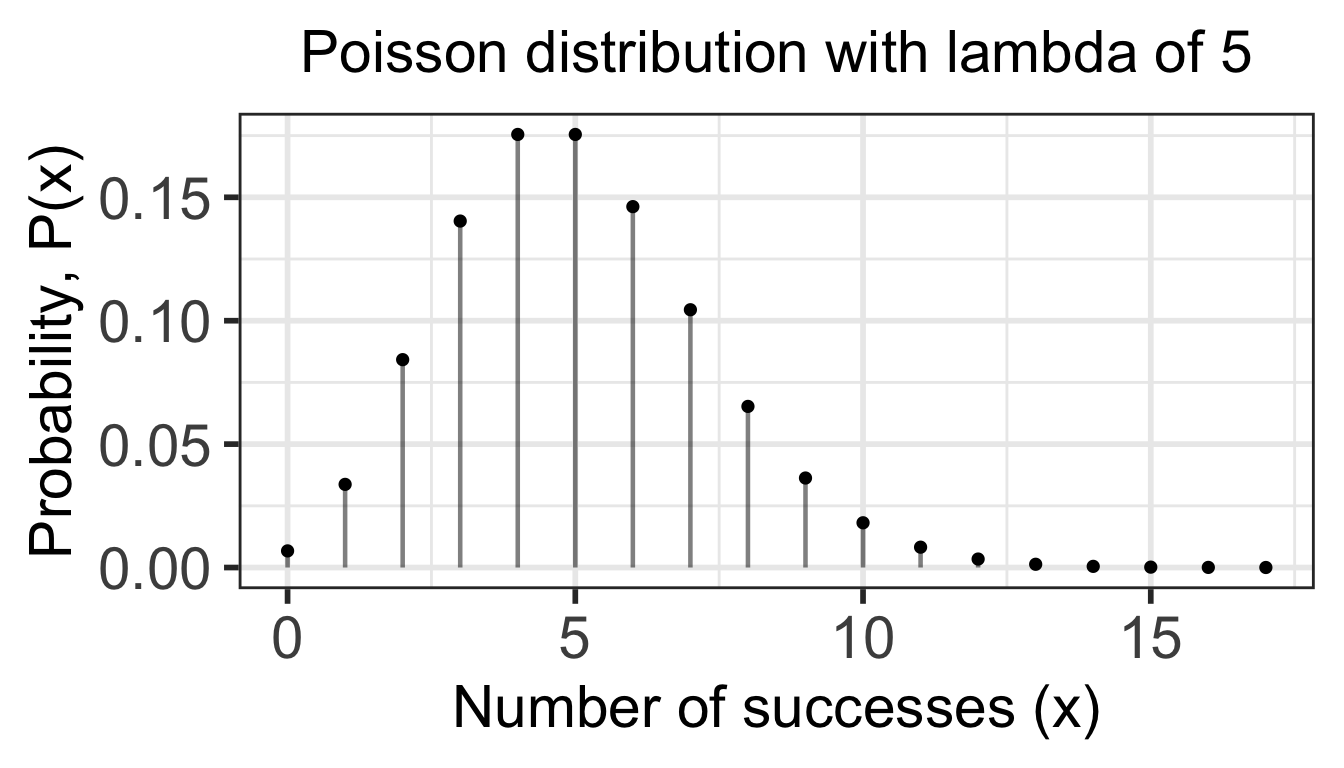
Suppose there are on average 5 deaths per year from typhoid fever over a 1-year period.
What is the probability of 3 deaths in a year?
What is the probability of 2 deaths in 0.5 years?
What is the probability of more than 12 deaths in 2 years?

Typhoid fever
Suppose there are on average 5 deaths per year from typhoid fever over a 1-year period.
\[P(X=3) = \frac{e^{-5}5^{3}}{3!} = 0.1404\]
Typhoid fever
Suppose there are on average 5 deaths per year from typhoid fever over a 1-year period.
\(\lambda = ?\) and we want \(P(X = 2)\)
\(\lambda=5\) was the rate for one year. When we want the rate for half year, we need to calculate a new \(\lambda\):
\[P(X=2) = \frac{e^{-2.5}2.5^{2}}{2!} = 0.0.2565\]
Typhoid fever
Suppose there are on average 5 deaths per year from typhoid fever over a 1-year period.
\(\lambda = ?\) and we want \(P(X > 12)\)
\[P(X>12) = 1 - P(X \leq 12) = 1 - \sum_{k=0}^{12}\frac{e^{-10}10^{k}}{k!} = 0.2084\]
Lesson 6 Slides