2025-04-28
Connect understanding of confounding and interactions from linear regression to logistic regression.
Determine if an additional independent variable is a not a confounder nor effect modifier, is a confounder but not effect modifier, or is an effect modifier.
Calculate and interpret fitted interactions, including plotting the log-odds, predicted probability, and odds ratios.
Determine if an additional independent variable is a not a confounder nor effect modifier, is a confounder but not effect modifier, or is an effect modifier.
Calculate and interpret fitted interactions, including plotting the log-odds, predicted probability, and odds ratios.
I think these slides from Northwestern do a really good job differentiating between confounders, mediators, and effect modifiers
https://www.feinberg.northwestern.edu/sites/bcc/docs/2016lectures/impactofotherfactors.pdf
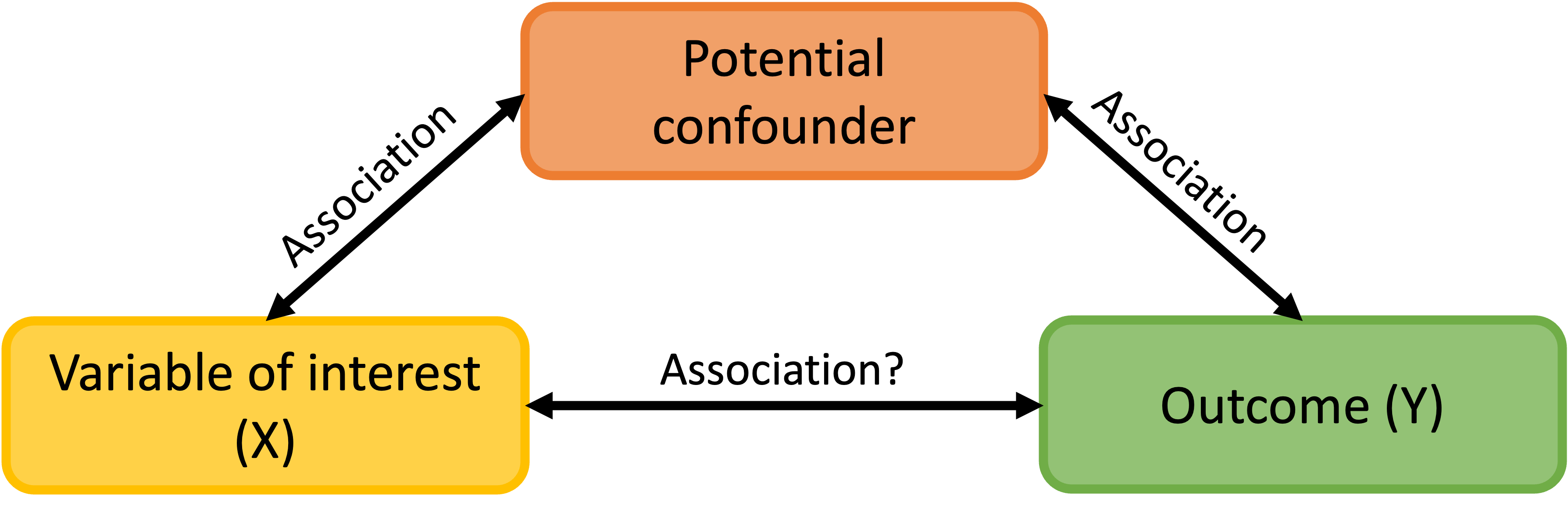
A confounding variable, or confounder, is a factor/variable that wholly or partially accounts for the observed effect of the risk factor on the outcome
A confounder must be…
In study that does not meet causal assumptions (retrospective, observational, case-control)…

\[\text{logit}\big(\pi(\bf{X}) \big)= \beta_0 + \beta_1X_{1}+ \beta_2X_{2}\]
Note: to interpret \(\beta_1\), we did not specify any value of \(X_2\); only specified that it be held constant
The above model assumes that \(X_{1}\) and \(X_{2}\) do not interact (with respect to their effect on \(Y\))
Epidemiology: no “effect modification”
Meaning the effect of \(X_{1}\) is the same regardless of the values of \(X_{2}\)
An additional variable in the model
An effect modifier will change the effect of \(X_1\) on \(Y\) depending on its value
Aka: as the effect modifier’s values change, so does the association between \(Y\) and \(X_1\)
So the coefficient estimating the relationship between \(Y\) and \(X_1\) changes with another variable
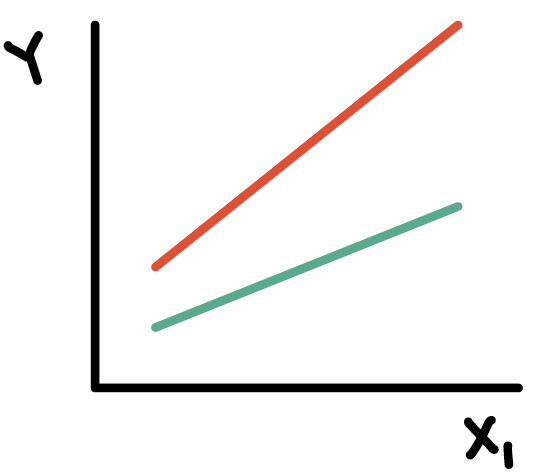
Confounders: The adjusted odds ratio for one variable adjusting for confounders can be quite different from unadjusted odds ratio
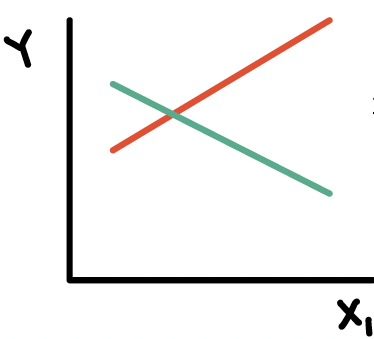
Interactions: When odds ratio for one variable is not constant over the levels of another variable, the two variables are said to have a statistical interaction (sometimes also called effect modification)
Note
Please refer to Lesson 11 from BSTA 512/612 – lots of information about these concepts!
Interactions!!
We can incorporate interactions into our model through product terms: \[\text{logit}\big(\pi(\bf{X}) \big)= \beta_0 + \beta_1X_{1}+ \beta_2X_{2} + \beta_3X_{1}X_{2}\]
Terminology:
main effect parameters: \(\beta_1,\beta_2\)
interaction parameter: \(\beta_3\)

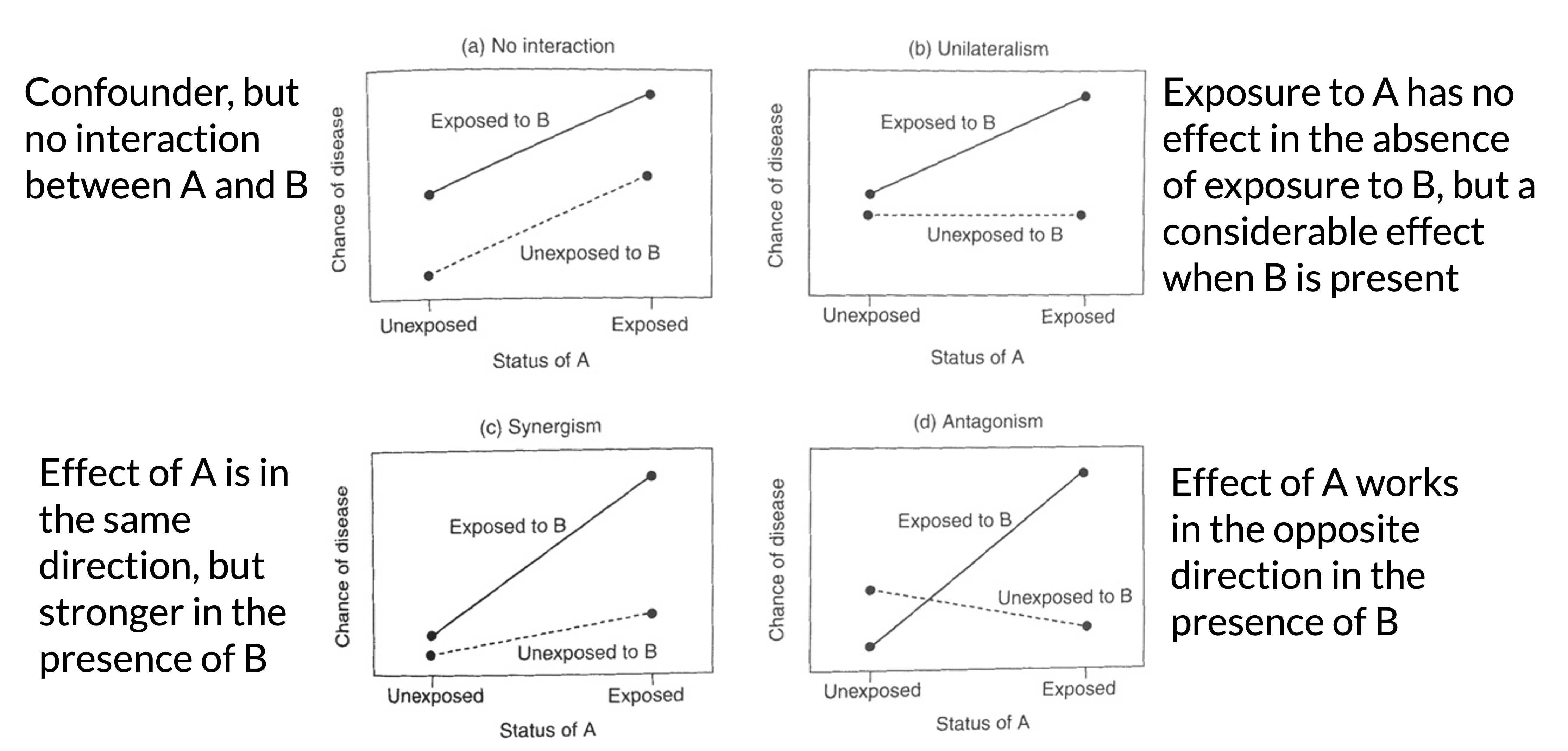
No interaction and three potential effects of interaction between two covariates A and B:

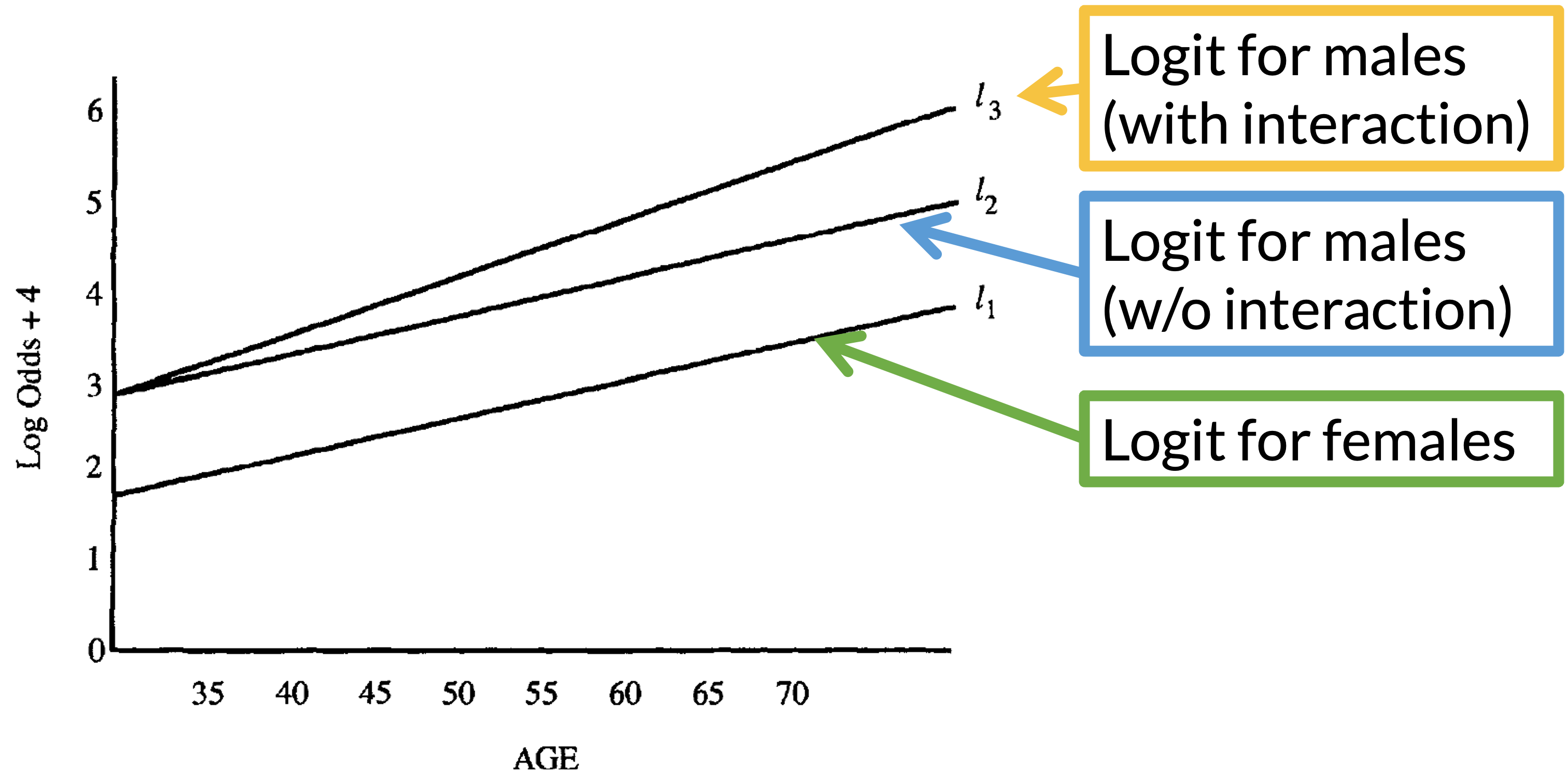
If age interacts with sex, the distance between \(l_3\) and \(l_1\) is the log odds ratio for sex, controlling for age.
Age values need to be specified because (\(l_3 - l_1\)) differs for different values of age.
Must specify age when reporting odds ratio comparing sex
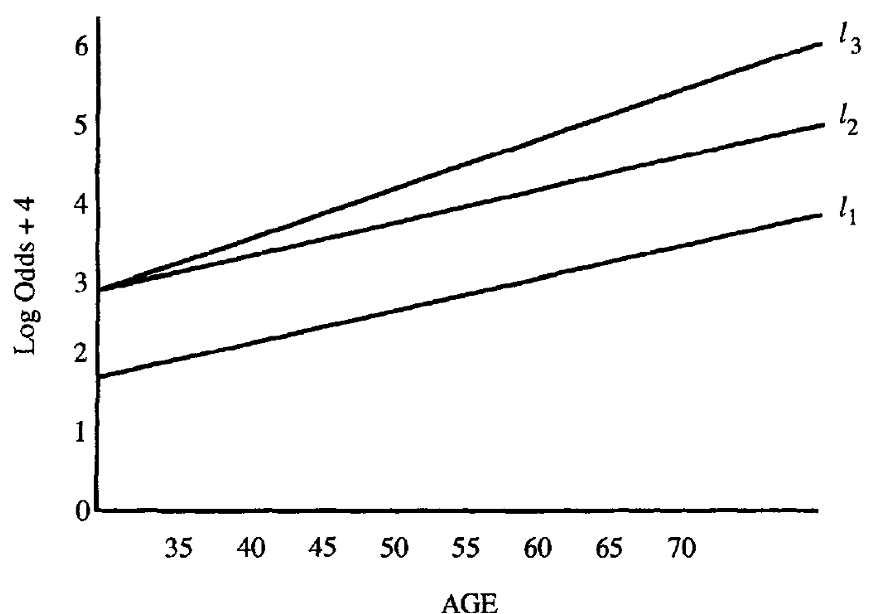
In the real world, it is rare to see two completely parallel logit plots as we see \(l_2\) and \(l_1\)

In a logistic model with two covariates : \(X_1\) (the risk factor, a binary variable) and \(X_2\) (potential confounder/effect modifier)
The role of \(X_2\) can be one of the three possibilities:
Not a confounder nor effect modifier, and not significantly associated with Y
No need to include \(X_2\) in the model (for your dataset)
May still be nice to include if other literature in the field includes it
It is a confounder but not an effect modifier. There is statistical adjustment but no statistical interaction
It is an effect modifier. There is statistical interaction.
This is more of a model selection question (in coming lectures)
But if we had a model with only TWO covariates, we could step through the following process:
Test the interaction (of potential effect modifier): use a partial F-test to test if interaction term(s) explain enough variation compared to model without interaction
Then look at the main effect (or potential confounder)
If interaction already included, then automatically included as main effect (and thus not checked for confounding)
For variables that are not included in any interactions:
We test with \(\alpha = 0.10\)
Follow the LRT procedure in Lesson 6, slide 38
Use the hypothesis tests for the specific covariate combo:
Binary & continuous variable
Testing a single coefficient for the interaction term using LRT comparing full model (with interaction) to reduced model (without interaction)
Binary & continuous variables
Testing a group of coefficients for the interaction term using LRT comparing full model (with interaction) to reduced model (without interaction)
Binary & multi-level variable
Testing a group of coefficients for the interaction term using LRT comparing full model (with interaction) to reduced model (without interaction)
Two continuous variables
Testing a single coefficient for the interaction term using LRT comparing full model (with interaction) to reduced model (without interaction)
If interaction already included:
For variables that are not included in any interactions:
If the main effect of the primary explanatory variable changes by less than 10%, then the additional variable is neither an effect modifier nor a confounder
Let’s say we have \(X_1\) and \(X_2\), and we specifically want to see if \(X_2\) is a confounder for \(X_1\) (the explanatory variable or variable of interest)
If we are only considering \(X_1\) and \(X_2\), then we need to run the following two models:
Fitted model 1 / reduced model (mod1): \(\text{logit}\left(\widehat\pi(\mathbf{X})\right) = \widehat\beta_0 + \widehat\beta_1X_1\)
Fitted model 2 / full model (mod2): \(\text{logit}\left(\widehat\pi(\mathbf{X})\right) = \widehat\beta_0 + \widehat\beta_1X_1 +\widehat\beta_2X_2\)
Calculation for % change in coefficient
\[ \Delta\% = 100\% \cdot\frac{\widehat\beta_{1, \text{mod1}} - \widehat\beta_{1, \text{mod2}}}{\widehat\beta_{1, \text{mod2}}} = 100\% \cdot \frac{\widehat\beta_{1, \text{red}} - \widehat\beta_{1, \text{full}}}{\widehat\beta_{1, \text{full}}} \]
Potential confounder or effect modifier: age (AGE, a continuous variable)
With a binary outcome, this is a little harder
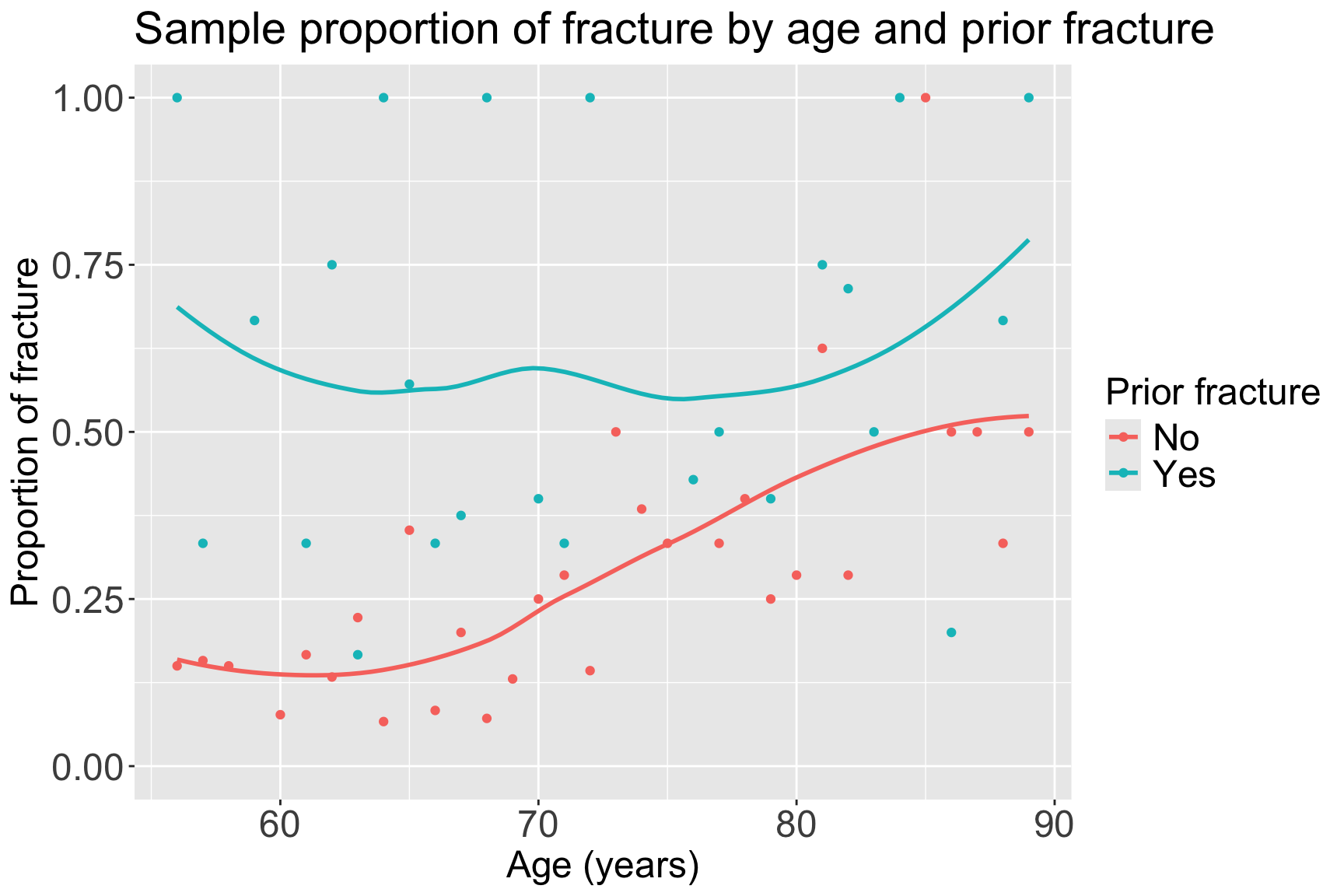
We could use a contingency table or plot proportions of the outcome
Hard to do this when our potential confounder or effect modifier is continuous
glow2 = glow %>%
group_by(age, priorfrac, fracture) %>% # last one needs to be outcome
summarise(n = n()) %>%
mutate(freq = n / sum(n)) %>% # takes the proportion of yes/no
filter(fracture == "Yes") # Filtering so only "success" shown
#filter(freq != 1 | n != 1)
head(glow2)# A tibble: 6 × 5
# Groups: age, priorfrac [6]
age priorfrac fracture n freq
<int> <fct> <fct> <int> <dbl>
1 56 No Yes 3 0.15
2 56 Yes Yes 1 1
3 57 No Yes 3 0.158
4 57 Yes Yes 1 0.333
5 58 No Yes 3 0.15
6 59 Yes Yes 2 0.667
ggplot(data = glow2, aes(y = freq, x = age, color = priorfrac)) +
geom_point() + ylim(0, 1) + geom_smooth(se = F) +
labs(x = "Age (years)", y = "Proportion of fracture",
color = "Prior fracture", title = "Sample proportion of fracture by age and prior fracture") +
theme(axis.title = element_text(size = 18), axis.text = element_text(size = 18),
title = element_text(size = 18), legend.text=element_text(size=18))We also could jump right into model fitting (connecting to the three possible roles of Age):
\[\text{logit}\left(\pi(\mathbf{X})\right) = \beta_0 + \beta_1\cdot I(\text{PF})\]
\[\text{logit}\left(\pi(\mathbf{X})\right) = \beta_0 + \beta_1\cdot I(\text{PF}) +\beta_2\cdot Age\]
\[\text{logit}\left(\pi(\mathbf{X})\right) = \beta_0 + \beta_1\cdot I(\text{PF}) +\beta_2\cdot Age + \beta_3 \cdot I(\text{PF}) \cdot Age\]
We also could jump right into model fitting (connecting to the three possible roles of Age):
| term | estimate | std.error | statistic | p.value | conf.low | conf.high |
|---|---|---|---|---|---|---|
| (Intercept) | −1.417 | 0.130 | −10.859 | 0.000 | −1.679 | −1.167 |
| priorfracYes | 1.064 | 0.223 | 4.769 | 0.000 | 0.626 | 1.502 |
| term | estimate | std.error | statistic | p.value | conf.low | conf.high |
|---|---|---|---|---|---|---|
| (Intercept) | −1.372 | 0.132 | −10.407 | 0.000 | −1.637 | −1.120 |
| priorfracYes | 0.839 | 0.234 | 3.582 | 0.000 | 0.378 | 1.297 |
| age_c | 0.041 | 0.012 | 3.382 | 0.001 | 0.017 | 0.065 |
| term | estimate | std.error | statistic | p.value | conf.low | conf.high |
|---|---|---|---|---|---|---|
| (Intercept) | −1.376 | 0.134 | −10.270 | 0.000 | −1.646 | −1.120 |
| priorfracYes | 1.002 | 0.240 | 4.184 | 0.000 | 0.530 | 1.471 |
| age_c | 0.063 | 0.015 | 4.043 | 0.000 | 0.032 | 0.093 |
| priorfracYes:age_c | −0.057 | 0.025 | −2.294 | 0.022 | −0.107 | −0.008 |
| term | estimate | std.error | statistic | p.value | conf.low | conf.high |
|---|---|---|---|---|---|---|
| (Intercept) | −1.417 | 0.130 | −10.859 | 0.000 | −1.679 | −1.167 |
| priorfracYes | 1.064 | 0.223 | 4.769 | 0.000 | 0.626 | 1.502 |
| term | estimate | std.error | statistic | p.value | conf.low | conf.high |
|---|---|---|---|---|---|---|
| (Intercept) | −1.372 | 0.132 | −10.407 | 0.000 | −1.637 | −1.120 |
| priorfracYes | 0.839 | 0.234 | 3.582 | 0.000 | 0.378 | 1.297 |
| age_c | 0.041 | 0.012 | 3.382 | 0.001 | 0.017 | 0.065 |
| term | estimate | std.error | statistic | p.value | conf.low | conf.high |
|---|---|---|---|---|---|---|
| (Intercept) | −1.376 | 0.134 | −10.270 | 0.000 | −1.646 | −1.120 |
| priorfracYes | 1.002 | 0.240 | 4.184 | 0.000 | 0.530 | 1.471 |
| age_c | 0.063 | 0.015 | 4.043 | 0.000 | 0.032 | 0.093 |
| priorfracYes:age_c | −0.057 | 0.025 | −2.294 | 0.022 | −0.107 | −0.008 |
Is age an effect modifier?
Test the significance of the interaction term in Model 3
We can use the Wald test or LRT
| term | estimate | std.error | statistic | p.value | conf.low | conf.high |
|---|---|---|---|---|---|---|
| (Intercept) | −1.417 | 0.130 | −10.859 | 0.000 | −1.679 | −1.167 |
| priorfracYes | 1.064 | 0.223 | 4.769 | 0.000 | 0.626 | 1.502 |
| term | estimate | std.error | statistic | p.value | conf.low | conf.high |
|---|---|---|---|---|---|---|
| (Intercept) | −1.372 | 0.132 | −10.407 | 0.000 | −1.637 | −1.120 |
| priorfracYes | 0.839 | 0.234 | 3.582 | 0.000 | 0.378 | 1.297 |
| age_c | 0.041 | 0.012 | 3.382 | 0.001 | 0.017 | 0.065 |
| term | estimate | std.error | statistic | p.value | conf.low | conf.high |
|---|---|---|---|---|---|---|
| (Intercept) | −1.376 | 0.134 | −10.270 | 0.000 | −1.646 | −1.120 |
| priorfracYes | 1.002 | 0.240 | 4.184 | 0.000 | 0.530 | 1.471 |
| age_c | 0.063 | 0.015 | 4.043 | 0.000 | 0.032 | 0.093 |
| priorfracYes:age_c | −0.057 | 0.025 | −2.294 | 0.022 | −0.107 | −0.008 |
Is age an effect modifier?
Test the significance of the interaction term in Model 3
We can use the Wald test or LRT
Short version of testing the interaction: Wald statistic for the interaction coefficient, \(\widehat{\beta}_3\), is statistically significant with \(p= 0.022\). Thus, there is evidence of a statistical interaction between these age and prior fracture.
We had lessons and homeworks dedicated to this process!
The process will be the same!
Connect understanding of confounding and interactions from linear regression to logistic regression.
Determine if an additional independent variable is a not a confounder nor effect modifier, is a confounder but not effect modifier, or is an effect modifier.
Must summarize the effect of prior fracture on current fracture by age
| term | estimate | std.error | statistic | p.value | conf.low | conf.high |
|---|---|---|---|---|---|---|
| (Intercept) | −1.376 | 0.134 | −10.270 | 0.000 | −1.646 | −1.120 |
| priorfracYes | 1.002 | 0.240 | 4.184 | 0.000 | 0.530 | 1.471 |
| age_c | 0.063 | 0.015 | 4.043 | 0.000 | 0.032 | 0.093 |
| priorfracYes:age_c | −0.057 | 0.025 | −2.294 | 0.022 | −0.107 | −0.008 |
| term | estimate | p.value | conf.low | conf.high |
|---|---|---|---|---|
| (Intercept) | −1.376 | 0.000 | −1.646 | −1.120 |
| priorfracYes | 1.002 | 0.000 | 0.530 | 1.471 |
| age_c | 0.063 | 0.000 | 0.032 | 0.093 |
| priorfracYes:age_c | −0.057 | 0.022 | −0.107 | −0.008 |
| term | estimate | p.value | conf.low | conf.high |
|---|---|---|---|---|
| (Intercept) | 0.25 | 0.00 | 0.19 | 0.33 |
| priorfracYes | 2.72 | 0.00 | 1.70 | 4.35 |
| age_c | 1.06 | 0.00 | 1.03 | 1.10 |
| priorfracYes:age_c | 0.94 | 0.02 | 0.90 | 0.99 |
\(\widehat\beta_3 = -0.057\)
The effect of having a prior fracture on the log odds of having a new fracture decreases by an estimated 0.057 for every one year increase in age (95% CI: 0.008, 0.107).
\(\widehat\beta_1 = 1.002\)
For individuals 69 years old, the estimated difference in log odds for a new fracture is 1.002 comparing individuals with a prior fracture to individuals with no prior fracture (95% CI: 0.530, 1.471).
\(\exp(\widehat\beta_1) = 2.72\)
For individuals 69 years old, the estimated odds of a new fracture for individuals with prior fracture is 2.72 times the estimated odds of a new fracture for individuals with no prior fracture (95% CI: 1.70, 4.35).
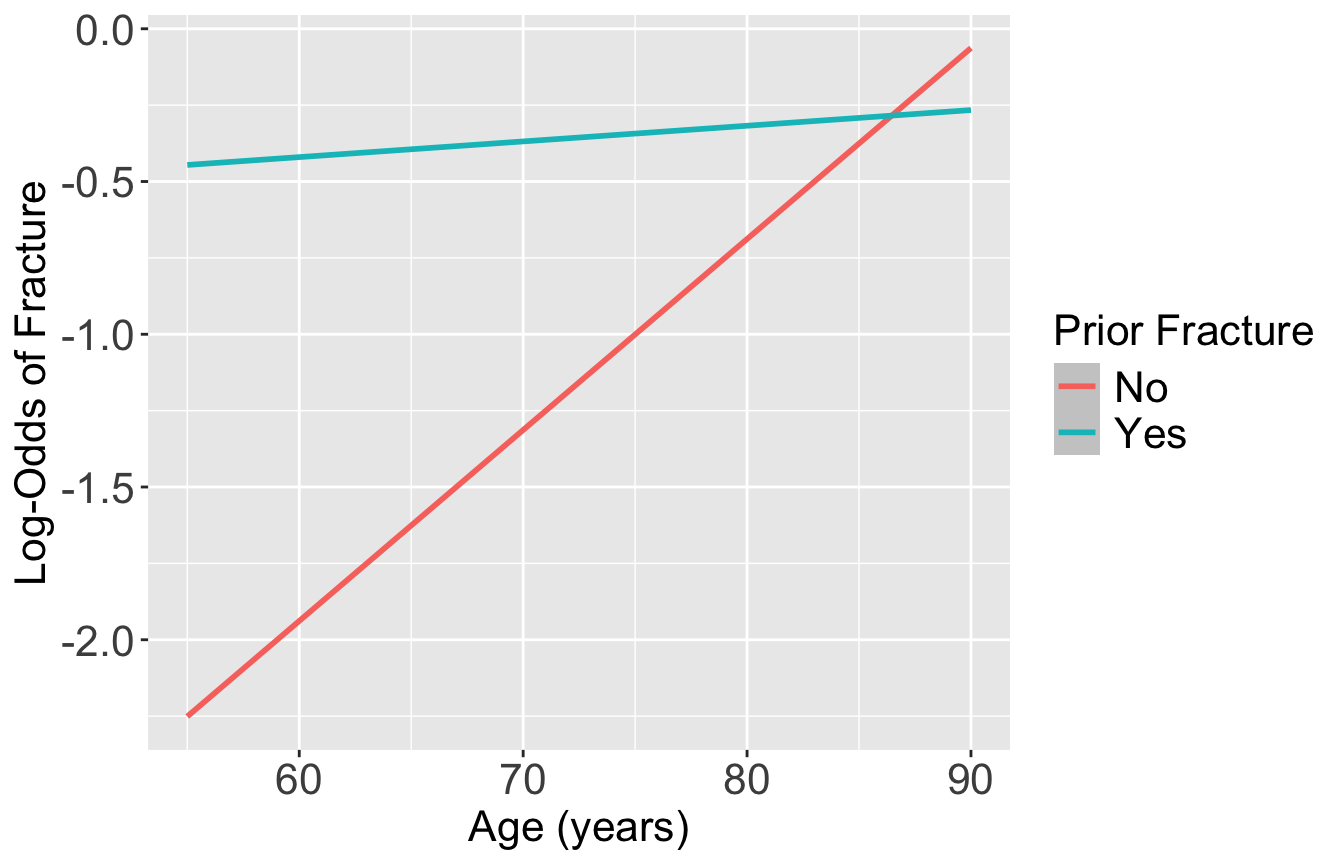
prior_age = expand_grid(priorfrac = c("No", "Yes"), age_c = (55:90)-69)
frac_pred_log = predict(glow_m3, prior_age, se.fit = T, type="link")
pred_glow2 = prior_age %>% mutate(frac_pred_log = frac_pred_log$fit,
age = age_c + mean_age)
ggplot(pred_glow2) + #geom_point(aes(x = age, y = frac_pred, color = priorfrac)) +
geom_smooth(method = "loess", aes(x = age, y = frac_pred_log, color = priorfrac)) +
theme(text = element_text(size=20), title = element_text(size=16)) +
labs(color = "Prior Fracture", x = "Age (years)", y = "Log-Odds of Fracture")frac_pred = predict(glow_m3, prior_age, se.fit = T, type="response")
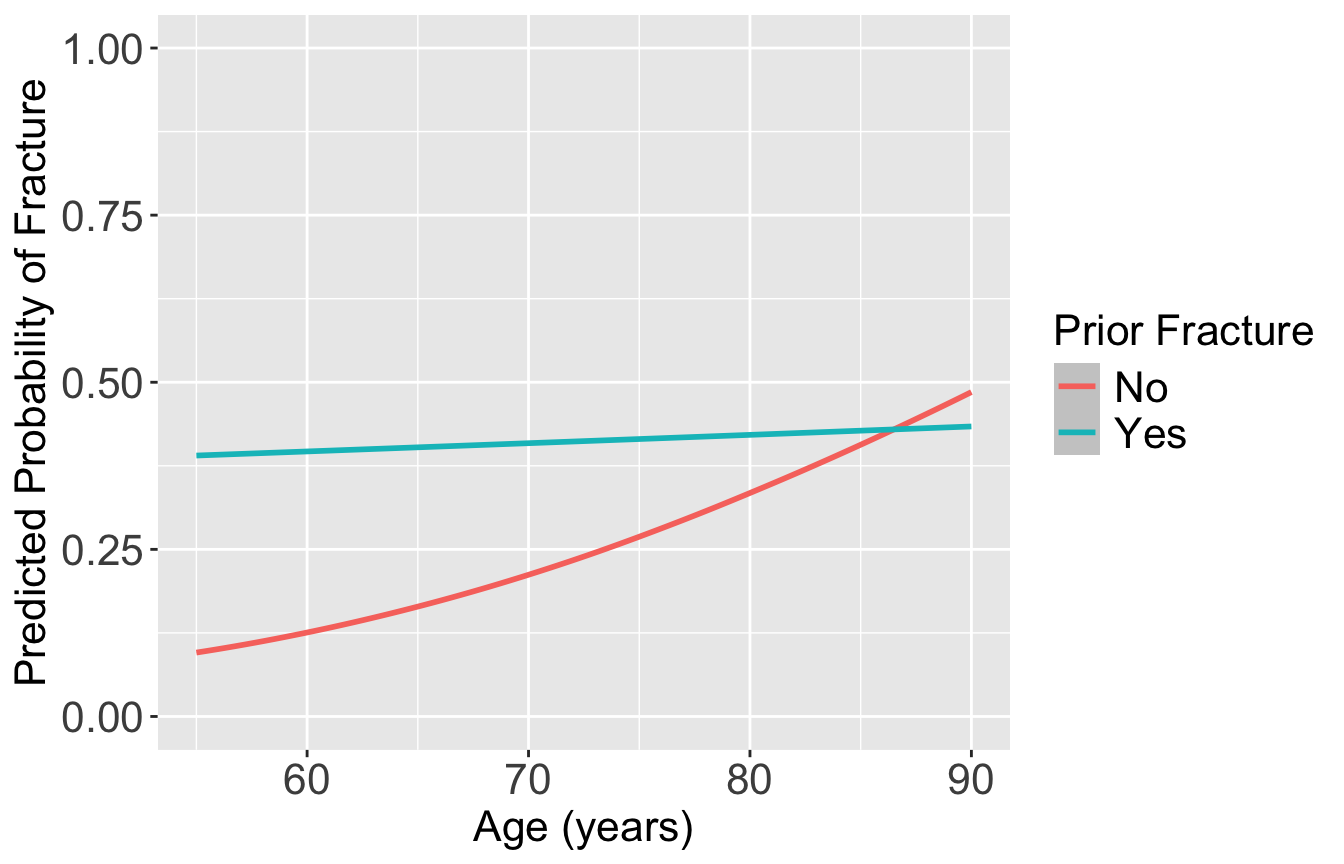
pred_glow = prior_age %>% mutate(frac_pred = frac_pred$fit,
age = age_c + mean_age)
ggplot(pred_glow) + #geom_point(aes(x = age, y = frac_pred, color = priorfrac)) +
geom_smooth(method = "loess", aes(x = age, y = frac_pred, color = priorfrac)) +
theme(text = element_text(size=20), title = element_text(size=16)) + ylim(0,1) +
labs(color = "Prior Fracture", x = "Age (years)", y = "Predicted Probability of Fracture")
When an interaction term (F*X) exists in the model
Assume we want to compute the odds ratio for (\(F = f_1\) and \(F = f_0\), the correct model-based estimate is \[\begin{aligned} {\widehat{OR}}_F = &\exp{\left(\hat{g}\left(F=f_1,X=x\right)-\hat{g}\left(F=f_0,X=x\right)\right)} \end{aligned}\]
\[ \begin{aligned} \hat{g}\left(F = f_1,X = x\right)&={\hat{\beta}}_0+{\hat{\beta}}_1f_1+{\hat{\beta}}_2x+{\hat{\beta}}_3f_1\cdot\ x \\ \hat{g}\left(F = f_0,X=x\right)&={\hat{\beta}}_0+{\hat{\beta}}_1f_0+{\hat{\beta}}_2x+{\hat{\beta}}_3f_0\cdot\ x \end{aligned}\]
\[ \begin{aligned} \hat{g}\left(f_1,x\right)-\hat{g}\left(f_0,x\right) & = \left[{\hat{\beta}}_0+{\hat{\beta}}_1f_1+{\hat{\beta}}_2x+{\hat{\beta}}_3f_1\cdot\ x \right] - \left[{\hat{\beta}}_0+{\hat{\beta}}_1f_0+{\hat{\beta}}_2x+{\hat{\beta}}_3f_0\cdot\ x \right] \\ \hat{g}\left(f_1,x\right)-\hat{g}\left(f_0,x\right) & = \hat{\beta}_1 f_1- \hat{\beta}_1f_0 + \hat{\beta}_3 x f_1 - \hat\beta_3 x f_0\\ \hat{g}\left(f_1,x\right)-\hat{g}\left(f_0,x\right) & = {\hat{\beta}}_1\left(f_1-f_0\right)+{\hat{\beta}}_3x\left(f_1-f_0\right) \end{aligned}\]
\[\widehat{OR}(F=f-1, F=f_0, X=x) = \widehat{OR}_F = \exp\left[ {\hat{\beta}}_1\left(f_1-f_0\right)+{\hat{\beta}}_3x\left(f_1-f_0\right) \right]\]
Identify two sets of values that you want to compare with only one variable changed
Substitute values in the fitted log-odds model
Take the difference of the two log-odds
Exponentiate the resulting difference
Identify two sets of values that you want to compare with only one variable changed
Set 1: \(PF = 1, Age = a\)
Set 2: \(PF = 0, Age = a\)
\[\text{logit}\left(\widehat\pi(\mathbf{X})\right) = \widehat\beta_0 + \widehat\beta_1\cdot I(\text{PF}) + \widehat\beta_2\cdot Age + \widehat\beta_3 \cdot I(\text{PF}) \cdot Age\] \[\begin{aligned} \text{logit}\left(\widehat\pi(PF = 1, Age = a)\right) =& \widehat\beta_0 + \widehat\beta_1\cdot 1 + \widehat\beta_2\cdot a + \widehat\beta_3 \cdot 1\cdot Age \\ =& \widehat\beta_0 + \widehat\beta_1 + \widehat\beta_2\cdot a + \widehat\beta_3\cdot a \end{aligned}\]
\[\begin{aligned} \text{logit}\left(\widehat\pi(PF = 0, Age = a)\right) =& \widehat\beta_0 + \widehat\beta_1\cdot 0 + \widehat\beta_2\cdot a + \widehat\beta_3 \cdot 0\cdot Age \\ =& \widehat\beta_0 + \widehat\beta_2\cdot a \end{aligned}\]
\[\begin{aligned} \left[logit\left(\pi\left(PF=1,\ Age=a\right)\right)\right]- & \left[logit\left(\pi\left(PF=0,\ Age=a\right)\right)\right] \\ & =\left[{\hat{\beta}}_0+{\hat{\beta}}_1+{\hat{\beta}}_2a+{\hat{\beta}}_3a\right]-\left[{\hat{\beta}}_0+{\hat{\beta}}_2a\right]\\ &={\hat{\beta}}_1+{\hat{\beta}}_3a \end{aligned}\]
\[\widehat{OR}\left[\left(PF=1,\ Age=a\right),\left(PF=0,\ Age=a\right)\right]=exp\ \left({\hat{\beta}}_1+{\hat{\beta}}_3a\right)\]
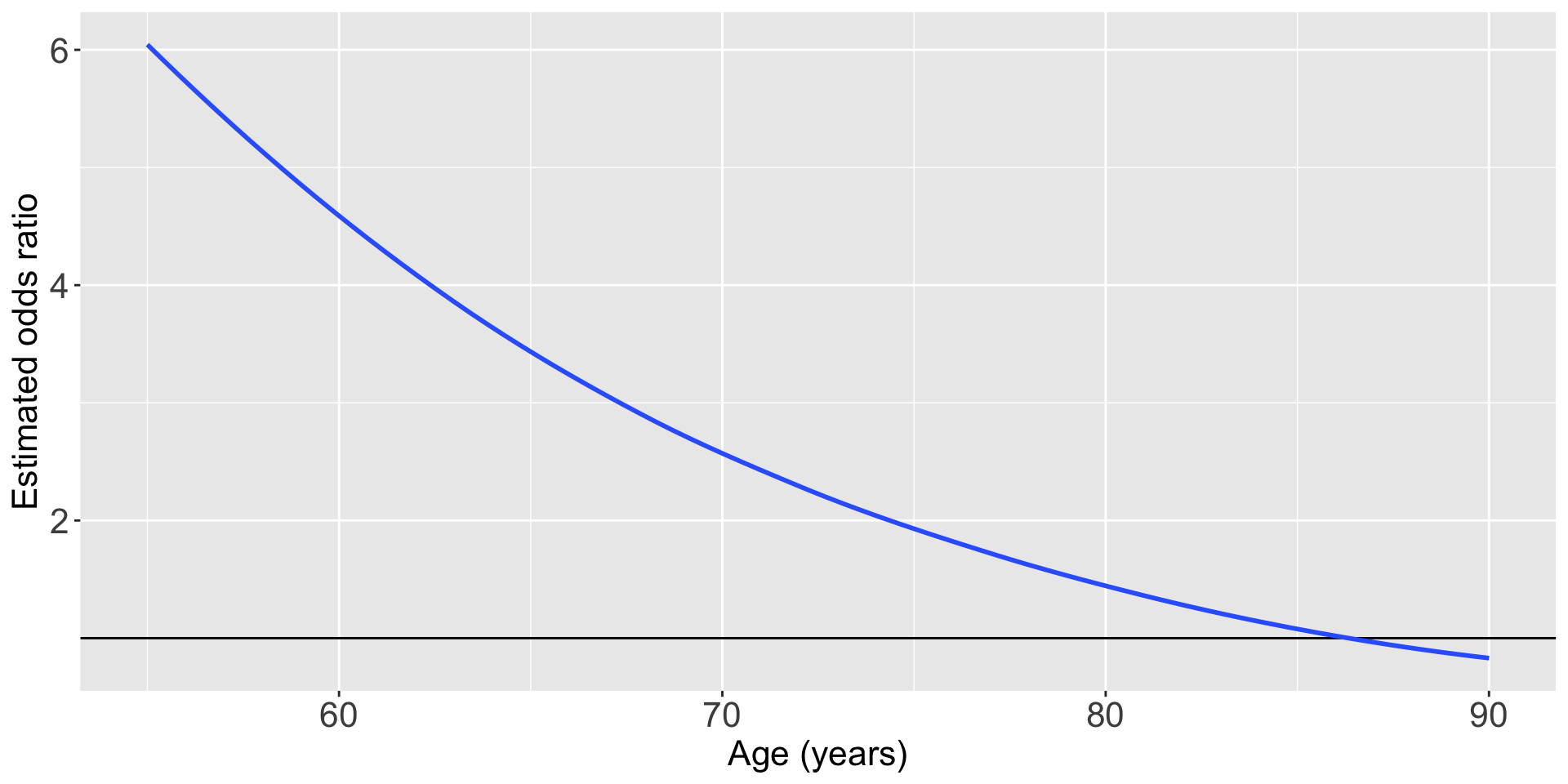
If we let \(a = 60\), i.e., compute OR for age = 60, then \[{\widehat{OR}}_{a=60}=\exp(1.002-0.057\cdot(60-69))\ =4.55\]
If we let \(a = 70\), i.e., compute OR for age = 70, then \[{\widehat{OR}}_{a=70}=\exp(1.002-0.057\cdot(70-69))\ =2.57\]
estimable())estimable() to calculate this linear combination of coefficients (see BSTA 512 Lesson)library(gmodels)
glow_m3 %>% estimable(
cbind("(Intercept)" = 0, # beta0
"priorfracYes" = 1, # beta1
"age_c" = 0, # beta2
"priorfracYes:age_c" = (55:90)-69),
conf.int = 0.95) %>%
exp(.) %>%
head(5) Estimate Std. Error X^2 value DF Pr(>|X^2|) Lower.CI Upper.CI
(0 1 0 -14) 6.081961 1.613392 1535383 2.718282 1.000161 2.354473 15.71063
(0 1 0 -13) 5.742790 1.578600 2324162 2.718282 1.000129 2.321435 14.20657
(0 1 0 -12) 5.422533 1.545094 3605103 2.718282 1.000102 2.287290 12.85533
(0 1 0 -11) 5.120136 1.512903 5721950 2.718282 1.000080 2.251861 11.64184
(0 1 0 -10) 4.834603 1.482070 9262667 2.718282 1.000062 2.214941 10.55260
predict())prior_age = expand_grid(priorfrac = c("No", "Yes"), age_c = (55:90)-69)
frac_pred_logit = predict(glow_m3, prior_age, se.fit = T, type="link")
pred_glow2 = prior_age %>% mutate(frac_pred = frac_pred_logit$fit,
age = age_c + mean_age) %>%
pivot_wider(names_from = priorfrac, values_from = frac_pred) %>%
mutate(OR_YN = exp(Yes - No))
head(pred_glow2)# A tibble: 6 × 5
age_c age No Yes OR_YN
<dbl> <dbl> <dbl> <dbl> <dbl>
1 -14 55 -2.25 -0.446 6.08
2 -13 56 -2.19 -0.441 5.74
3 -12 57 -2.13 -0.436 5.42
4 -11 58 -2.06 -0.430 5.12
5 -10 59 -2.00 -0.425 4.83
6 -9 60 -1.94 -0.420 4.56
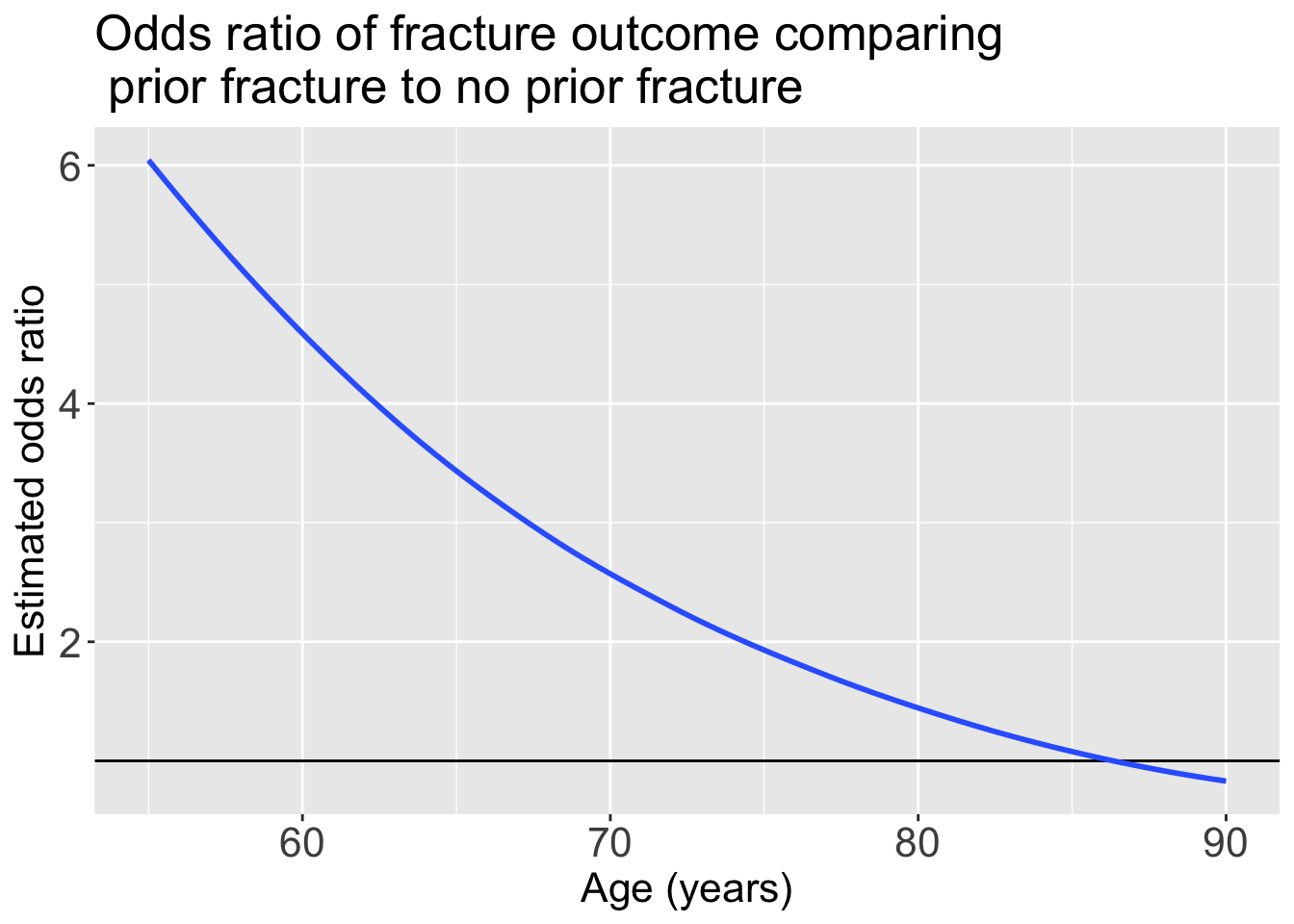
ggplot(pred_glow2) +
geom_hline(yintercept = 1) +
geom_smooth(method = "loess", aes(x = age, y = OR_YN)) +
theme(text = element_text(size=20), title = element_text(size=16)) +
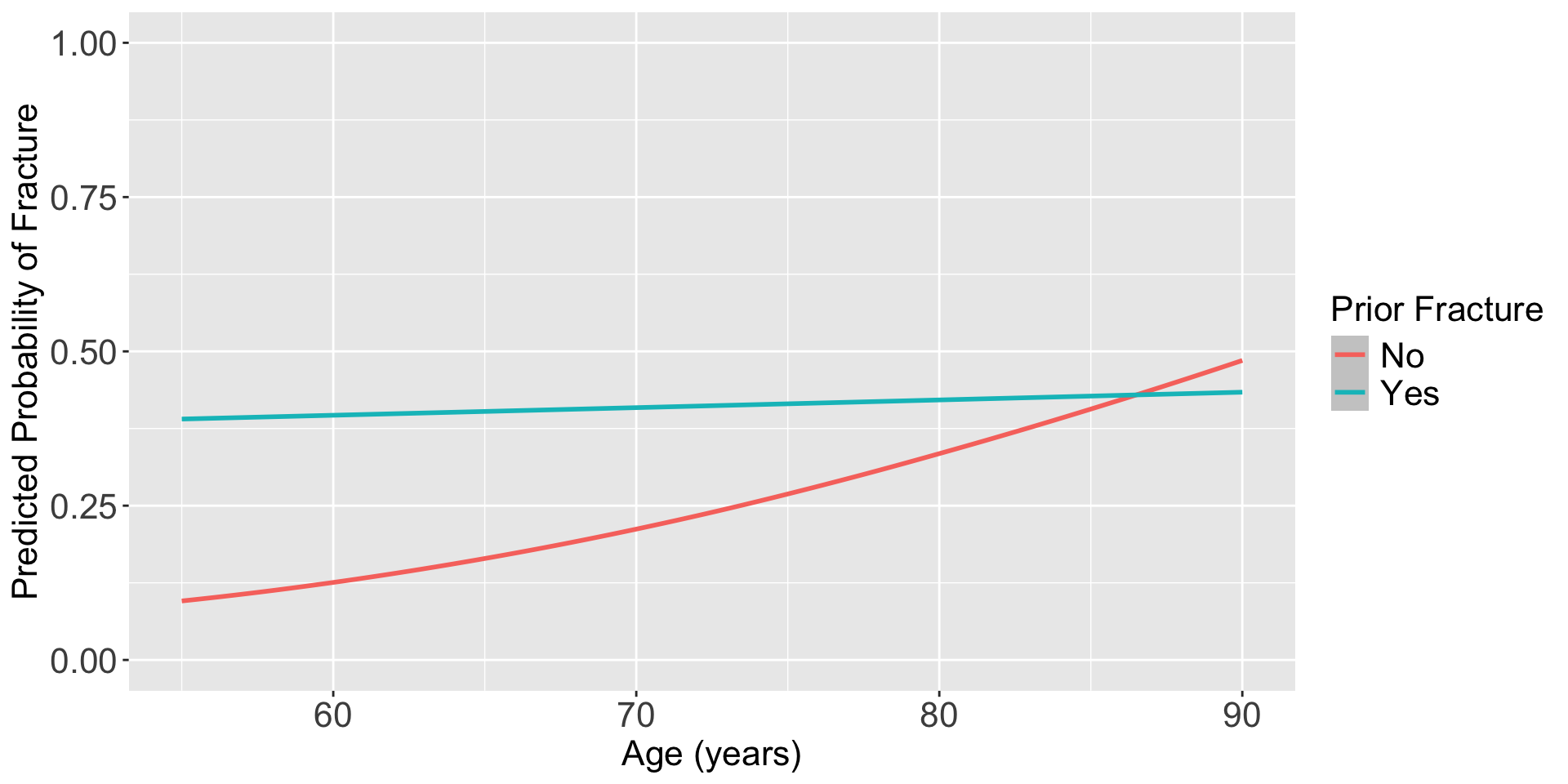
labs(x = "Age (years)", y = "Estimated odds ratio", title = "Odds ratio of fracture outcome comparing \n prior fracture to no prior fracture")For individuals 69 years old, the estimated odds of a new fracture for individuals with prior fracture is 2.72 times the estimated odds of a new fracture for individuals with no prior fracture (95% CI: 1.70, 4.35). As seen in Figure 1 (a), the estimated odds ratio of a new fracture when comparing prior fracture status decreases with age, indicating that the effect of prior fractures on new fractures decreases as individuals get older. In Figure 1 (b), it is evident that for both prior fracture statuses, the predicted probability of a new fracture increases as age increases. However, the predicted probability of new fracture for those without a prior fracture increases at a higher rate than that of individuals with a prior fracture. Thus, the predicted probabilities of a new fracture converge at age [insert age here].
Lesson 10: Interactions